Volumetric pipettes are among the most accurate liquid measuring instruments used in laboratories. A Class A volumetric pipette is designed to deliver a single fixed volume with extremely tight tolerances, making it the preferred choice for analytical chemistry, pharmaceutical testing, clinical laboratories and scientific research where precise measurements are essential. However, achieving that level of accuracy also depends on correct handling, calibration and proper laboratory technique.
From preparing standard solutions to dispensing reference samples and performing quantitative assays, accurate liquid measurement directly influences the reliability of laboratory results. Choosing high-quality Volumetric Pipettes helps laboratories maintain measurement consistency while supporting safe and efficient laboratory workflows.
This guide explains what makes volumetric pipettes so accurate, the differences between Class A and Class B instruments, and the factors that influence measurement precision in everyday laboratory practice.
What Is a Volumetric Pipette and What Makes It Different?
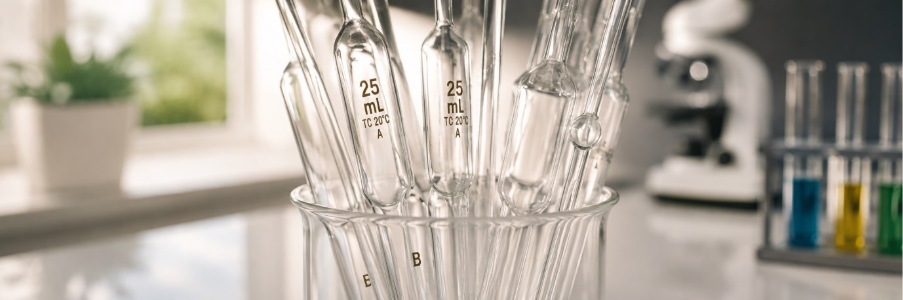
A volumetric pipette (also known as a bulb pipette or transfer pipette) is a single-volume glass measuring instrument designed to deliver one fixed, highly accurate volume of liquid. Unlike graduated pipettes, which are marked with multiple graduation points along the stem, a volumetric pipette has a single calibration mark on the neck above a large central bulb. This design concentrates manufacturing precision into a single measurement, rather than distributing tolerance across an entire graduated scale.
This single-mark construction is what gives volumetric pipettes their accuracy advantage. The tolerance for a Class A 25 mL volumetric pipette under Australian and international standards is typically plus or minus 0.03 mL, representing an error of just 0.12 per cent of the total volume delivered. For comparison, a 25 mL graduated pipette of equivalent quality carries a tolerance roughly three to five times wider.
What Do Accuracy Classes Mean for Volumetric Pipettes?
Class A vs Class B: Volumetric pipettes are manufactured to two principal accuracy classes:
Class A: Pipettes meet the highest tolerance specifications and are intended for analytical, pharmaceutical, and research-grade work where measurement error must be minimised. They are individually calibrated and traceable to national measurement standards.
Class B: Pipettes carry tolerances approximately twice as wide as Class A and are appropriate for general laboratory use, educational settings, and preparative work where the highest level of precision is not critical. For school science laboratories and general bench work, Class B pipettes are entirely fit for purpose. For quantitative analytical chemistry, pharmaceutical compounding, and any application where results will be used for regulatory, clinical, or research reporting purposes, Class A is the correct specification.
To complete your laboratory setup, explore Livingstone’s Laboratory Pipettes and Pipette Accessories collection for compatible pipettes, replacement accessories and laboratory essentials designed for accurate and efficient liquid handling.
How Should Volumetric Pipettes Be Calibrated and Verified?
For laboratories operating under quality management systems, including NATA-accredited facilities, periodic verification of pipette accuracy is a documented requirement. The gravimetric method is the standard approach: a known volume of distilled water is dispensed into a tared vessel and weighed. Using the density of water at the measured temperature, the mass is converted to volume and compared against the nominal pipette volume.
The National Measurement Institute Australia provides guidance on volumetric instrument calibration and measurement traceability as part of its role in supporting Australian laboratory standards (National Measurement Institute Australia 2023). Laboratories seeking NATA accreditation or maintaining ISO/IEC 17025 compliance should refer to these standards when establishing their pipette verification schedules.
Quick Reference: Factors Affecting Volumetric Pipette Accuracy
| Factor | Effect on Accuracy | Corrective Action |
|---|---|---|
| Parallax error at meniscus | Systematic over or under-fill | Eye level with calibration mark |
| Blowing out residual | Delivers excess volume | Allow free drainage only |
| Incomplete drainage | Delivers less than nominal volume | Allow full drainage time |
| Contaminated inner surface | Uneven drainage and residue | Clean and rinse before use |
| Temperature deviation from 20°C | Minor volume error | Apply temperature correction for high-precision work |
Conclusion
Volumetric pipettes remain the benchmark for high-precision liquid measurement when accuracy is critical. Whether used in analytical chemistry, pharmaceutical testing, clinical laboratories or scientific research, they deliver consistent and reliable results when operated correctly and maintained according to recognised laboratory standards.
While Class A pipettes provide the highest level of measurement accuracy, both Class A and Class B instruments can perform exceptionally well within their intended applications. By following proper handling techniques, maintaining clean equipment and carrying out routine verification, laboratories can maximise measurement accuracy and ensure dependable results across a wide range of testing and analytical procedures.
References
- National Measurement Institute Australia 2023, Volumetric laboratory glassware calibration and traceability, Australian Government, viewed 13 July 2026.
- Safe Work Australia 2022, Managing risks of hazardous chemicals in the workplace, Safe Work Australia, Australian Government, viewed 13 July 2026.