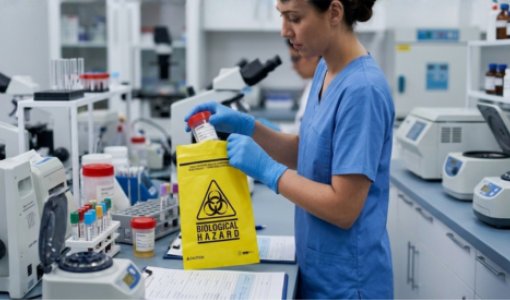
Laboratory liquid storage and dispensing directly affect sample integrity, staff safety and compliance across Australian laboratories, including pathology, school science and industrial testing facilities. Similar liquid handling practices may also apply in clinical environments such as dental and podiatry settings where controlled storage or dispensing is required. Poorly chosen containers or unmanaged dispensing methods can increase the risk of contamination, evaporation, chemical incompatibility and spillage. Many laboratories improve handling consistency by pairing storage bottles with a dedicated storage bottle tap, which allows controlled pouring without repeatedly opening or tipping the container. This guide outlines what Australian laboratories and relevant clinical environments should consider when improving liquid storage and dispensing practices.
Why Does Proper Liquid Storage Matter in Laboratories?
Correct liquid storage protects sample and reagent quality, prevents reactions between incompatible substances, and reduces workplace hazards such as spills, fumes and container failure. It is a foundational requirement of laboratory safety and is closely tied to work health and safety compliance across Australian jurisdictions.
Liquids stored in unsuitable containers can degrade, evaporate or leach contaminants that affect test results. Some laboratory chemicals are also incompatible with one another, and mixing them, even accidentally through poor segregation, can cause fires, toxic fume release or corrosion of storage containers. Establishing sound storage practice from the outset minimises these risks and supports consistent, reliable laboratory outcomes.
What Are the Key Requirements for Safe Laboratory Liquid Storage?
Safe laboratory liquid storage requires compatible containers, clear labelling, proper segregation and suitable environmental controls. These measures reduce contamination risks, chemical reactions, spills and container failure during storage and handling.
Material Compatibility and Container Selection
Container material should always match the liquid being stored. High-density polyethylene (HDPE) is widely used for many laboratory liquids because it provides good chemical resistance for a range of applications. However, compatibility depends on the specific liquid, concentration, temperature and exposure conditions, so suitability should always be confirmed using the chemical manufacturer’s guidance or SDS before selection. HDPE is lightweight and does not shatter like glass, while glass remains preferable for certain organic solvents and light-sensitive reagents. Checking the safety data sheet (SDS) for each liquid before selecting a container helps reduce the risk of material failure over time.
Labelling and Segregation
Every stored liquid should be clearly labelled with its contents, hazard classification and date of decanting where relevant. Incompatible chemicals, such as oxidisers and flammables, should be physically separated to reduce the chance of a dangerous reaction if a container fails or a spill occurs.
Environmental Controls and Spill Containment
Temperature, ventilation and secondary containment all influence storage safety. Bunding, a raised impermeable barrier used to contain leaks, is a standard control for larger volumes of hazardous liquids and helps prevent spills from reaching drains, floors or the wider environment.
How Can Laboratories Improve Liquid Dispensing Efficiency and Safety?
Dispensing is often where contamination and spill risk is highest, since it involves direct handling of an open or partially open container. Controlled dispensing equipment reduces manual handling, limits exposure to fumes and vapours, and improves the accuracy of the volume being poured.
Controlled Dispensing Systems
A compatible tap fitted to a storage bottle allows liquid to be dispensed in a controlled stream without repeatedly lifting, tilting or opening the container. This can help reduce over pouring, limit unnecessary exposure to air and support more consistent handling of sensitive liquids. Dispensing performance depends on the tap design, cleaning practices and suitability of the system for the stored liquid. Keeping the main stock container stable during dispensing can also support safer and more efficient laboratory workflows.
Reducing Spill and Exposure Risks
Manual pouring from an open container increases the likelihood of splashing, dripping and skin or eye exposure, particularly with corrosive or irritant liquids. Dispensing systems that direct flow to a fixed point, combined with appropriate personal protective equipment, help reduce these risks during routine laboratory work.
Supporting Workflow and Ergonomics
Beyond safety, controlled dispensing improves day-to-day workflow. Staff spend less time managing awkward pouring tasks, waste from overfilling is reduced, and consistent dispensing volumes support more repeatable results across a laboratory team.
What Standards and Guidelines Apply to Laboratory Liquid Storage in Australia?
Australian laboratories storing hazardous chemicals should refer to Safe Work Australia’s guidance on identifying and separating incompatible chemicals, which outlines the risks of fire, toxic gas release and container corrosion when substances are stored together incorrectly (Safe Work Australia, n.d.). Where larger volumes are held on site, secondary containment expectations set out by state environmental regulators, such as bunding sized to contain a spill of the stored liquid, provide a further layer of protection against pollution incidents (NSW Environment Protection Authority, n.d.). Meeting these obligations is not just a compliance exercise. It directly reduces the likelihood of workplace incidents and supports safer, more consistent laboratory operations.
What is the best container for storing laboratory liquids?
HDPE wide-neck bottles suit most aqueous solutions and general-purpose reagents, as they are chemically resistant, lightweight and shatterproof. Glass is generally preferred for certain organic solvents and light-sensitive substances. The safety data sheet for the specific liquid should always guide container choice.
How often should laboratory storage containers be inspected?
Containers should be checked before each use and as part of routine safety inspections, looking for cracks, discolouration, brittleness or a degraded seal. Damaged containers should be replaced immediately to prevent leaks or contamination.
Do dispensing taps reduce contamination risk in a laboratory?
Yes. A dispensing tap limits contact between the liquid, the outside air and external surfaces, which reduces the risk of contamination and evaporation compared with repeatedly opening a container to pour by hand.
Is bunding required for laboratory liquid storage?
Bunding requirements depend on factors such as the chemical type, stored volume, hazard classification and applicable state or territory requirements. Where secondary containment is required or considered appropriate, bunding can help contain spills before they reach floors, drains or the wider environment. Laboratories should confirm storage requirements against relevant regulations, chemical risk assessments and workplace procedures.
References
Safe Work Australia (n.d.) Storing hazardous chemicals. (Accessed: 23 September 2026).
NSW Environment Protection Authority (n.d.) Bunding requirements at liquid waste treatment facilities. (Accessed: 23 September 2026).