A serious road accident, a workplace fall, or a sporting collision can all lead to the same urgent concern: a suspected spinal injury. In these moments, the equipment and decisions of the first responder can influence the casualty’s outcome long before paramedics arrive. An extrication cervical collar is one of the most recognisable pieces of trauma equipment used in these situations, but its role in modern first aid practice is more nuanced than many people realise. This guide explains what an extrication cervical collar is, how it fits into current Australian first aid guidelines, and what workplace first aid officers should know before using one.

What Is an Extrication Cervical Collar?
An extrication cervical collar is a semi-rigid device designed to limit movement of the head and neck while a casualty with a suspected spinal injury is assessed, moved, or transported. Unlike a soft foam collar, which simply signals that spinal precautions are in place, a semi-rigid extrication collar is built to provide firmer support around the jaw, chin, and base of the skull. This makes it a standard piece of equipment in vehicle extrication, workplace incident response, and pre-hospital trauma care.
Design details vary between manufacturers, but most extrication collars share a rigid outer shell, a padded inner lining, and an adjustable sizing mechanism. Because an adult extrication cervical collar is shaped and sized differently to a paediatric extrication cervical collar, first aid officers need to select the correct version for the casualty in front of them, a point explored further below.
Why Do First Aid Officers Need to Understand Cervical Collar Use?
Workplace first aid officers, especially those trained under advanced or occupational first aid units, are often the first trained responders on the scene of a traumatic incident. This may occur in industrial settings, construction sites, schools, aged care facilities, or during transport of patients between clinical areas. Understanding when and how an extrication cervical collar is used, and equally, when manual support alone is the safer option, helps ensure first aid officers act within their training and in line with current evidence.
Adult and Paediatric Cervical Collars: Why Correct Sizing Matters
A collar that is too loose will fail to limit movement, while one that is too tight can restrict the airway or increase pressure around the neck. Adult and paediatric casualties have different neck lengths, jaw structures, and tissue sensitivity, which is why separate adult and paediatric extrication collars are used rather than a single adjustable design. First aid officers responsible for stocking trauma or vehicle response kits should ensure both sizes are available where children may reasonably be present, such as schools, childcare centres, and family workplaces.
What Do Current Guidelines Say About Cervical Collar Use in First Aid?
Evidence and guidance around spinal immobilisation have evolved considerably over the past decade. First aid officers should be aware that current Australian guidance draws a clear distinction between basic first aid response and the use of semi-rigid extrication collars by trained personnel.
ANZCOR Guidance for First Aid Providers
The Australian and New Zealand Committee on Resuscitation (ANZCOR) advises that for basic first aid, manual support of the head and neck in a neutral position is the recommended initial management of a suspected spinal injury, rather than routine application of a semi-rigid collar. ANZCOR notes that semi-rigid collars carry risks, including pressure injury and increased intracranial pressure, and that their use is better suited to trained rescue and extrication personnel who can apply them correctly and monitor the casualty throughout transport.
Workplace First Aid Obligations Under Safe Work Australia
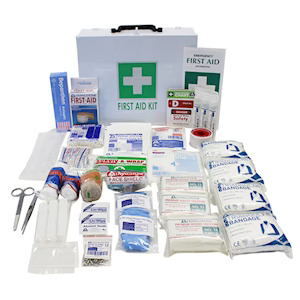
Under the Safe Work Australia Model Code of Practice: First Aid in the Workplace, the type of first aid equipment a workplace needs are determined through a risk assessment of the specific hazards present. Businesses with higher exposure to trauma risk, such as transport, construction, or emergency response roles, may reasonably include extrication cervical collars as part of their trauma response equipment, provided staff hold the appropriate level of first aid training to use them safely.
How Should an Extrication Cervical Collar Be Applied?
For first aid officers trained and authorised to use one, correct application generally follows this sequence:
- One responder maintains manual in-line stabilisation of the head and neck before the collar is fitted.
- The correct collar size is measured against the casualty’s neck, using the manufacturer’s sizing guide.
- The collar is slid into place without forcing movement of the head or neck.
- Manual stabilisation is maintained until the collar is fully secured and checked for fit.
- The casualty’s airway, breathing, and comfort are reassessed immediately after the collar is applied.
What Are Common Mistakes When Using Cervical Collars?
The most frequent errors include selecting an incorrect size, releasing manual stabilisation too early, applying a collar over thick clothing or jewellery, and leaving a collar in place without reassessing the casualty’s airway. First aid officers should also avoid applying a semi-rigid collar outside the scope of their training, as ANZCOR guidance specifically cautions against this in basic first aid contexts.
FAQ:
Does every workplace first aid kit need a cervical collar?
No. Whether a cervical collar is required depends on a workplace risk assessment under the Safe Work Australia model code, and on whether staff hold the training needed to use one safely.
Is cervical collar application taught in standard first aid courses?
Basic first aid courses generally focus on manual spinal support rather than collar application. Occupational or advanced first aid units of competency may include collar use as part of a broader trauma response module.
What is the difference between a soft collar and a semi-rigid extrication collar?
A soft collar offers minimal support and mainly signals spinal precautions, while a semi-rigid extrication collar provides firmer stabilisation around the jaw and skull base and is intended for use by trained personnel during extrication and transport.
References
- Australian and New Zealand Committee on Resuscitation (ANZCOR) 2023, Guideline 9.1.6 – Management of Suspected Spinal Injury, ANZCOR, viewed 23 July 2026,
- Safe Work Australia 2018, Model Code of Practice: First Aid in the Workplace, Safe Work Australia, Canberra, viewed 23 July 2026.
- St John Ambulance Australia 2022, Spinal and Neck Injury, St John Ambulance Australia, Deakin, viewed 23 July 2026.