A childcare centre floor carries more health risk than most people realise. Infants crawl across it, toddlers nap on it, and children spend hours at eye level with every surface they touch. The mop head and handle a centre chooses, and how consistently colour coding is followed, plays a direct role in preventing illness. This guide explains how to choose the right colour coded mop head and handle.
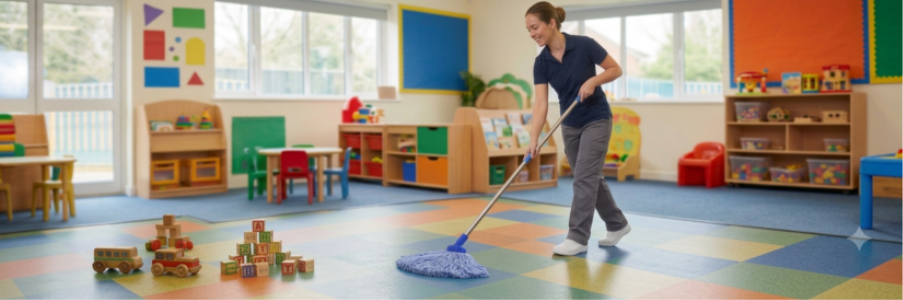
How to Choose the Right Mop Head and Handle for Childcare Hygiene?
Maintaining effective floor hygiene in childcare settings requires a cleaning system that supports consistent procedures and helps reduce the risk of cross contamination. Childcare centres should use colour-coded, low linting cotton mop heads that are suited to specific cleaning areas and replaced at regular intervals to maintain cleaning performance.
Colour-coded mop heads are essential to childcare hygiene and should provide reliable absorption, effective soil removal and compatibility with existing cleaning equipment. A 400g cotton mop head with a 22mm screw type fitting is suitable for different childcare areas, supporting routine cleaning across classrooms, play spaces, rest areas, bathrooms and other high-use or high-risk areas where effective floor hygiene is essential. Choosing the correct mop head helps reduce the spread of dirt and contaminants, particularly in areas exposed to frequent spills, bodily fluids or increased foot traffic.
The mop head should also be paired with a suitable handle to support safe and efficient cleaning practices. A 150cm Corrugated Aluminium Mop Handle provides a practical working height for most childcare cleaning tasks, helping staff maintain a comfortable posture while navigating around furniture, cots and play equipment. Its lightweight construction makes it suitable for routine cleaning schedules across various areas of a childcare centre.
Using compatible mop heads and handles as part of a structured cleaning system helps childcare teams maintain consistent hygiene practices while supporting a safer environment for children and educators. A well-matched cleaning system improves efficiency, supports staff comfort and helps maintain clean, hygienic spaces throughout the day.
What colour mop head is used for childcare cleaning?
Childcare centres usually use a four colour system, red, blue, green, and yellow, to separate mop heads by area and prevent cross contamination between high risk zones such as bathrooms and lower risk zones such as classrooms. Each colour is dedicated to one zone only.
Colour coding removes guesswork for cleaning staff and helps new team members learn the system quickly. This same red, blue, green, and yellow structure underpins environmental cleaning standards across NSW healthcare and care settings (NSW Health, 2023), a system already trusted in Australian health environments.
Red mop heads for bathrooms and nappy change areas
Red mop heads stay dedicated to toilets, bathrooms, and nappy change areas, the highest risk zones in a childcare centre. Keeping red separate stops waste related bacteria from reaching classrooms, kitchens, or sleep areas.
Blue mop heads for classrooms and communal areas
Blue mop heads suit classroom floors, hallways, and communal areas, the everyday, lower risk cleaning that makes up most of a centre’s daily routine, using the same 350g cotton head with a 22mm screw fitting for consistent daily use.
Green mop heads for kitchens and food preparation
Green mop heads keep kitchens and food preparation areas separated from every other zone, so food contact surfaces are never cleaned with a mop that has touched a bathroom or nappy change area.
Yellow mop heads for isolation areas and sick bays
Yellow mop heads isolate cleaning for sick bays, keeping unwell children’s spaces separate from the rest of the centre. This stops illness spreading to well children through a shared mop.
Formalising colour coding into a written cleaning policy also makes it easier to demonstrate consistent hygiene practice during NQS assessment visits (ACECQA, 2026).
How often should childcare centres replace mop heads?
Childcare centres should replace mop heads every one to three months under normal daily use, or immediately if fraying, discolouration, persistent odour, or reduced absorbency appears. High traffic zones such as bathrooms and kitchens often need more frequent replacement than general classroom areas.
A red mop head used daily in a bathroom wears out faster than a blue mop head used in a quieter hallway, so many centres stagger replacement by colour zone rather than replacing everything on the same date. A simple log of replacement dates helps staff stay consistent and gives management an easy record for audits. Watch for frayed strands, which trap soil and bacteria, and a musty smell after washing, a sign the head should be discarded.
How do childcare centres prevent cross contamination when cleaning floors?
Childcare centres prevent cross contamination by pairing a strict colour coded mop system with correct laundering, defined replacement schedules, and separate storage for each colour, so heads never touch or drip onto one another and every zone stays protected.
Storage matters as much as the cleaning itself. Mop heads should hang to air dry rather than sit in a bucket, since a damp environment encourages bacterial growth even on a well maintained head. Wall mounted hooks separated by colour zone keep the system clear, aligning with health practice expectations under Quality Area 2 (ACECQA, 2026).
Choosing the right mop head and handle is a small decision with a meaningful impact on daily health. A consistent, colour coded system, matched with a firm replacement schedule, gives families confidence in the standard of care their children receive.
References
- Australian Children’s Education and Care Quality Authority (ACECQA) 2026, Element 2.1.2: Health practices and procedures, ACECQA, Sydney, viewed 21 July 2026,
- NSW Health 2023, Cleaning of the Healthcare Environment, Policy Directive PD2023_018, NSW Ministry of Health, Sydney, viewed 21 July 2026.