Selecting the correct disinfectant for each zone of a childcare centre is a core infection control decision, not a routine purchasing task. Surfaces such as nappy change stations, play furniture and shared toys are used by multiple children within short periods, and the grade of product applied materially affects the level of protection achieved. Commercial-grade and hospital-grade disinfectants are formulated for different risk levels and are not interchangeable.
This article sets out the distinction between the two categories, the zones each is appropriate for, correct application technique, and how a childcare service can build a compliant, zone-based disinfection system.

What Is the Difference Between Commercial-Grade and Hospital-Grade Disinfectants?
Commercial-grade disinfectants are formulated for general, low-risk surfaces and do not require listing on the Australian Register of Therapeutic Goods, while hospital-grade disinfectants are regulated by the Therapeutic Goods Administration and must carry a valid ARTG listing to verify efficacy against a broader spectrum of pathogens.
Livingstone supplies both grades required to cover a childcare centre’s full range of surfaces. From routine, everyday cleaning, to the centre’s highest-risk zones. Choosing the right one for each area is what keeps illness from spreading between children, and what gives assessors and families confidence that your service takes hygiene seriously.
Where Should Commercial-Grade Disinfectant Be Used?
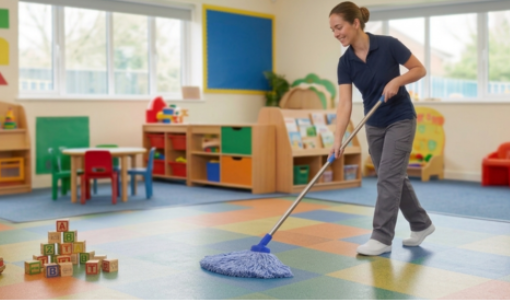
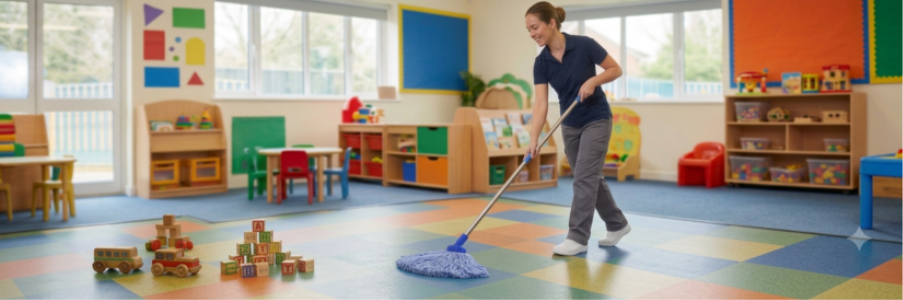
Commercial-grade disinfectant is appropriate for routine daily cleaning of general, low-risk areas such as play furniture, floors, outdoor equipment and shared toys, where the objective is to reduce common bacteria rather than achieve clinical level pathogen elimination.
The Livingstone Commercial Grade Disinfectant 15L Drum (Eucalyptus) suits daily cleaning volume of a busy centre, cutting down on how often staff need to reorder. Its fresh scent also gives families and visitors an immediate, reassuring sign that a space has just been cleaned, without being harsh or overpowering in rooms full of young children.
It is appropriate for play furniture, floors, outdoor equipment, shared toys during routine daily cleaning, and kitchen benches outside of active food preparation periods.
Where Should Hospital-Grade Disinfectant Be Used?
Hospital-grade disinfectant is required in a centre’s highest-risk zones, including nappy change stations, toileting surfaces and any surface contaminated with bodily fluids, where independently verified, broad-spectrum pathogen control is a regulatory expectation rather than an optional upgrade.
Livingstone Kovit Hospital Grade Disinfectant 5L is registered on the Australian Register of Therapeutic Goods (ARTG 367530), which is the assurance a childcare service actually needs when a policy states hospital-grade disinfectant is used in nappy change areas. Its pink colouring is a simple but effective safeguard: staff can see at a glance which bottle is for high-risk clean-ups and which is for everyday surfaces, so there is no room for a childcare team member to grab the wrong one. It is required at nappy change stations after every single use, on bathroom and toileting surfaces throughout the day, on any surface contaminated with bodily fluids, and in sick bay or isolation areas.
Why Does Disinfectant Grade Matter So Much in Childcare Settings?
Children aged zero to five have immune systems that are still maturing, and group care environments accelerate the spread of pathogens including rotavirus, norovirus, RSV and Staphylococcus aureus. Applying the correct disinfectant grade to each surface is a health and safety requirement, not a matter of preference.
Common pathogens circulating in Australian childcare environments include:
- Rotavirus, a leading cause of severe gastroenteritis, surviving on hard surfaces for extended periods.
- Norovirus, which spreads through contaminated surfaces and can affect an entire group within hours.
- Respiratory Syncytial Virus (RSV), a significant cause of hospitalisation in infants under twelve months.
- Hand, Foot and Mouth Disease, spread through saliva, mucus and faecal matter, endemic in childcare settings.
- Staphylococcus aureus, transferred by skin contact and persisting on inadequately disinfected surfaces.
Effective cleaning and disinfection of surfaces is one of the most reliable strategies for reducing transmission of infectious illness in early childhood settings (National Health and Medical Research Council, 2024). A commercial-grade product will not achieve the pathogen kill required in high-risk zones; a hospital-grade, TGA registered product will.
How Should Disinfectants Be Applied Correctly in a Childcare Setting?
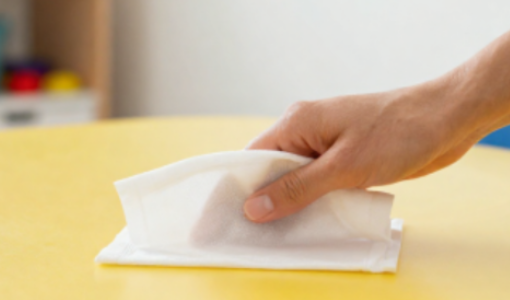
Correct application requires cleaning the surface first to remove organic matter, then applying the disinfectant and allowing it to remain wet for the full contact time of 5 minutes, since organic residue and premature wiping both reduce the product’s effectiveness regardless of its grade.
The correct sequence, mandatory for high-risk zones, is:
- Clean the surface first with detergent and warm water to remove dirt, mucus or faecal material, as organic matter blocks the disinfectant from making effective contact.
- Apply the disinfectant and allow the full contact time of 5 minutes. Removing it before this time is complete significantly reduces efficacy.
- Dispose of cleaning materials and wash hands thoroughly, even after removing gloves.
Additional errors to avoid include incorrect dilution, since over-dilution reduces efficacy while under-dilution may damage surfaces without improving performance, using expired stock as formulations degrade over time, and substituting commercial-grade for hospital-grade product in high-risk zones, which is a compliance failure regardless of cleaning frequency.
How Do You Build a Zone-Based Disinfection System for a Childcare Centre?
A zone-based system designates which disinfectant grade is required in which area, trains staff to apply that standard consistently, and documents it in the centre’s cleaning schedule and chemical register, turning the commercial-grade and hospital-grade allocations set out above into a repeatable, auditable routine rather than a judgement call made in the moment.
How Can Childcare Teams Build a Culture of Infection Control?
Stocking the correct products is a necessary starting point, but infection control is only genuinely effective once staff understand which product belongs in which zone, why the grade distinction matters, and how to apply the two-step clean-then-disinfect process correctly and consistently.
Childcare directors and nominated supervisors are responsible for establishing and modelling these standards. Regular review of cleaning procedures, combined with accessible product placement and clear labelling, allows correct practice to become routine rather than a point of confusion. A commercial-grade product for daily cleaning, paired with a TGA registered hospital-grade disinfectant for high-risk zones, gives a childcare service a system that is both practical to run and fully compliant.
References
- National Health and Medical Research Council (2024) Staying Healthy: Preventing Infectious Diseases in Early Childhood Education and Care Services. Australian Government.
- Therapeutic Goods Administration (2024) Understanding the Regulation of Disinfectants, Sterilants and Sanitary Products. Australian Government Department of Health.