Bi-concave, bi-convex, concave and convex lenses each bend light differently, helping students explore image formation, light refraction and the principles behind optical systems. Converging lenses focus light to produce real or magnified images, while diverging lenses spread light rays to create virtual images, making them essential for hands-on science experiments.
As a core topic in the Australian science curriculum, optics helps students connect classroom theory with practical applications found in technologies such as glasses, cameras and microscopes. Livingstone’s School Science Lab Physics range supports these investigations with curriculum-aligned equipment, while the School Science Lab Physics Optics collection includes educational lenses, optical benches and classroom resources for practical physics and STEM learning.
This guide explains the four lens types most commonly used in school laboratory experiments, how each one affects light and where it is best applied in the classroom.
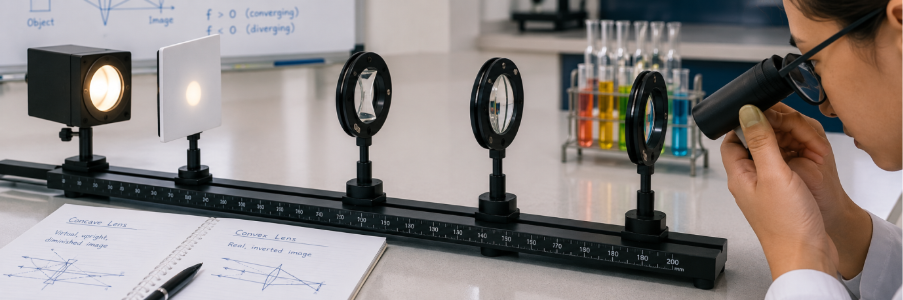
What Are the Main Types of Lenses Used in School Science?
Lenses used in school optical experiments fall into two broad categories: converging lenses, which bring light rays together, and diverging lenses, which spread light rays apart. The curvature of each lens determines how strongly it refracts light and the type of image it produces.
The four lens types commonly found in school laboratory optics kits are the bi-convex lens, bi-concave lens, plano-convex (convex) lens, and plano-concave (concave) lens.
Bi-Convex Lenses: Bringing Light to a Focus
A bi-convex lens curves outward on both surfaces. Both faces are convex, meaning the lens is thicker in the centre than at the edges. This geometry causes parallel light rays entering the lens to converge at a single point on the far side, known as the focal point.
What Experiments Use Bi-Convex Lenses?
- Focal length measurement: Students direct a parallel beam of light through the lens and measure the distance from the lens to the point where the beam converges. This distance is the focal length, a fundamental optical property.
- Image formation investigations: By placing an object at varying distances from the lens and recording the position and nature of the image formed (real or virtual, upright or inverted, magnified or diminished), students explore the lens equation and ray diagrams experimentally.
- Simple magnifier demonstrations: A bi-convex lens held close to an object produces a magnified virtual image, illustrating the principle behind magnifying glasses and eyepiece lenses in microscopes.
Bi-Concave Lenses: Spreading Light Apart
A bi-concave lens curves inward on both surfaces, making it thinner in the centre than at the edges. Unlike a bi-convex lens, it causes parallel light rays to diverge after passing through, as though they originated from a virtual focal point on the same side as the incoming light.
What Experiments Use Bi-Concave Lenses?
- Diverging lens behaviour: Students trace light rays through a bi-concave lens, locating the virtual focal point by extending diverging rays backward, reinforcing the concept of negative focal lengths.
- Corrective lens modelling: Bi-concave lenses model myopia correction. Combining them with a bi-convex lens demonstrates how diverging and converging elements interact, connecting classroom optics directly to real-world applications.
- Lens combination experiments: Placing both lens types in series lets students investigate combined focal lengths, extending understanding beyond single-lens systems.
Plano-Convex and Plano-Concave Lenses
Both types have one flat face and one curved face. The flat surface contributes no refraction, so all optical power comes from the single curved surface. Plano-convex lenses are used where a gentler converging effect is needed, including telescope modelling and single-surface refraction investigations. Plano-concave lenses demonstrate divergence at a single surface and are effective in compound optical system experiments. Their flat face simplifies alignment on an optical bench, making them practical for junior and senior students alike.
How Are These Lenses Used on an Optical Bench?
An optical bench is the standard platform for controlled lens experiments in school laboratories. It allows lenses, light sources, and screens to be positioned along a graduated rail, making it straightforward to measure object distance, image distance, and focal length with precision.
A typical progression through a school optics unit involves measuring focal length with a bi-convex lens, investigating image formation at multiple object distances, comparing converging effects across lens types, locating virtual foci with bi-concave lenses, and combining lens types to model corrective optics or compound instruments.
Curriculum Relevance Across Australian Science Syllabuses
Lens experiments are a component of the physical sciences strand across multiple year levels in the Australian Curriculum: Science. Investigations involving image formation, ray diagrams, and the behaviour of converging and diverging lenses appear in Years 8 through 10, with more quantitative treatment in senior physics courses.
ACARA’s science curriculum framework emphasises hands-on investigation as the primary method for developing scientific understanding. Lens experiments are well-suited to this approach because results are immediate, observable, and directly linked to the theoretical models students study in class (Australian Curriculum, Assessment and Reporting Authority 2022). Well-structured optics investigations develop measurement skills that carry directly into senior physics and STEM pathways.
Quick Reference: Lens Types and Their School Laboratory Applications
| Lens Type | Shape | Light Behaviour | Key School Applications |
|---|---|---|---|
| Bi-convex | Curved out on both sides | Converges (focuses) | Focal length, image formation, magnification |
| Bi-concave | Curved in on both sides | Diverges (spreads) | Virtual focus, myopia modelling, lens combinations |
| Plano-convex | Flat one side, curved out one side | Converges (moderate) | Single surface refraction, telescope modelling |
| Plano-concave | Flat one side, curved in one side | Diverges (moderate) | Single surface divergence, corrective optics |
Building a Strong Foundation in Optics
Understanding how bi-convex, bi-concave, convex and concave lenses interact with light helps students connect scientific theory with real-world applications. Through practical experiments, they can observe image formation, measure focal length and explore the principles of refraction in a meaningful and engaging way.
By incorporating hands-on optical investigations into science lessons, educators can reinforce key curriculum concepts while developing students’ observation, measurement and critical thinking skills. These practical experiences not only support learning outcomes in physics but also encourage curiosity and build a solid foundation for future study in STEM fields.
References
Australian Curriculum, Assessment and Reporting Authority 2022, Australian Curriculum: Science, ACARA, viewed 13 July 2026.
Wolfe, J 2024, Lenses and images: geometrical optics, School of Physics, University of New South Wales, viewed 13 July 2026.