A cardiac arrest does not leave much time for someone to remember what came next in a training course they completed months ago. Even people who have learned CPR can benefit from having the recognised resuscitation sequence visible where an emergency may occur.
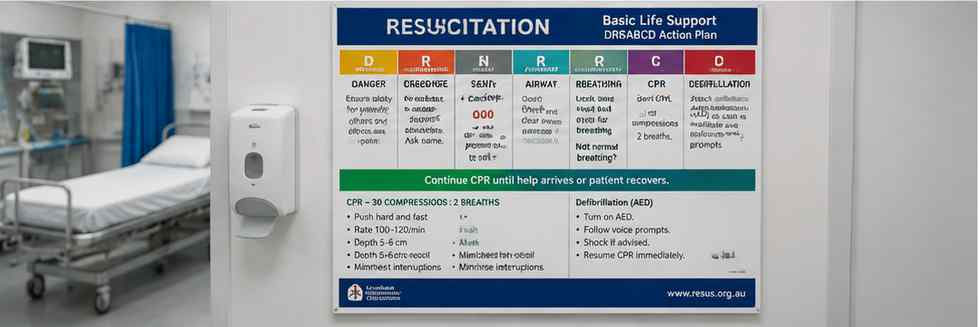
Livingstone A2 laminated resuscitation chart provides a wall-based reference that can be positioned in treatment rooms, first aid areas and other suitable locations. Its A2 format provides space for resuscitation information to be presented as a visible reference rather than stored away with first aid supplies.
Safe Work Australia’s Model Code of Practice includes instructions for providing first aid, including a CPR flow chart, in its example first aid kit contents. Workplaces reviewing wall-based emergency information can also explore Livingstone’s Chart Collections for related display options.
What Is a Resuscitation Chart Used for in a Workplace?
A resuscitation chart provides an easily visible reference to the recognised steps for responding to a person who is unresponsive and not breathing normally. It complements CPR training by keeping the emergency sequence accessible in first aid areas, treatment rooms, and other appropriate workplace locations.
ANZCOR’s current CPR guideline uses the DRS ABCD sequence: check for Danger, check for Response, send for help, open the Airway, check Breathing, begin CPR and use Defibrillation when an AED becomes available.
The value of a wall chart is not that someone should stop during an emergency and read lengthy instructions. Its role is much simpler. A clearly positioned visual reference keeps the basic sequence familiar and provides another source of guidance in the environment where first aid may be given.
It can also form part of everyday first aid awareness. Staff regularly passing a chart are exposed to the sequence outside formal training sessions.
Importantly, a chart does not replace accredited CPR or first aid training. Safe Work Australia recommends trained first aiders attend training regularly to keep their knowledge current.
Why Should CPR Instructions Be Clearly Visible?
CPR instructions should be visible because an emergency response depends on recognising what to do and acting promptly. A wall-mounted reference makes the basic resuscitation sequence readily accessible without requiring someone to locate a manual, open a first aid kit, or search for instructions during a time-critical situation.
Visibility matters before an incident as much as during one.
Safe Work Australia states that workers should receive information about first aid, including equipment locations, trained first aiders and procedures to follow when first aid is required. It also identifies visual methods such as posters as one way of providing first aid information.
- first aid and treatment rooms
- staff areas near first aid equipment
- medical and dental practices
- aged care facilities
- childcare workplaces
- laboratories and workshops
- manufacturing and food processing facilities
- community and government workplaces
What CPR Information Should Staff Be Familiar With?
Staff should recognise when CPR is required and understand the basic DRS ABCD response sequence. Current ANZCOR guidance states that CPR should begin when a person is unresponsive and not breathing normally, using 30 chest compressions followed by two breaths, with an AED attached as soon as available.
Current ANZCOR guidance recommends a compression rate of approximately 100 to 120 compressions per minute and advises rescuers to minimise interruptions.
Those details demonstrate an important distinction between a resuscitation reference and training.
Reading a laminated CPR wall chart can reinforce the sequence, but practical training teaches a person how to assess an emergency and perform CPR appropriately. The two therefore serve different purposes.
A sensible workplace approach combines current training, accessible first aid equipment, clear emergency procedures and visual information rather than treating any one of these as sufficient by itself.
Where Should a Laminated CPR Wall Chart Be Displayed?
A laminated CPR wall chart should be placed where it can be seen quickly and where first aid or emergency response is reasonably likely to occur. Appropriate locations can include first aid rooms, treatment areas, staff facilities and spaces near first aid equipment or an automated external defibrillator.
Accessibility is the key consideration.
Safe Work Australia advises that first aid kits should be positioned where workers can see and access them quickly, with additional consideration given to areas where there is a higher risk of injury or illness. Similar practical thinking can be applied when deciding where emergency information belongs.
A laminated format is particularly practical for shared work environments because the surface is better suited to routine handling and cleaning than an unprotected paper poster.
- hidden behind an open door
- covered by stored equipment
- difficult to see from normal standing height
- located far from the relevant first aid area
- exposed to unnecessary damage
How Do You Choose a Resuscitation Chart for a Healthcare or Workplace Setting?
Choose a resuscitation chart by checking whether its information reflects current Australian guidance, whether the format is large enough for the intended location and whether the surface suits the environment. Placement, readability and periodic review are more important than selecting a chart simply because it fits an available wall space.
Start with the information itself. Resuscitation guidance can change, so old posters should not remain indefinitely simply because they are still physically intact.
Then consider format.
The Livingstone A2 Resuscitation Chart is supplied as a laminated A2 chart, making it suitable for displaying resuscitation information as a dedicated wall reference.
- chart dimensions and viewing distance
- clarity of the resuscitation sequence
- suitability for wall display
- laminated versus unprotected paper construction
- proximity to first aid equipment
- whether existing charts contain current information
Facilities managing several treatment or first aid areas may also want to review their broader range of first aid and healthcare charts rather than assessing each location in isolation.
When Should a Workplace Replace or Review Its Resuscitation Chart?
A workplace should review its resuscitation chart when recognised resuscitation guidance changes, during scheduled first aid inspections, after workplace changes or whenever the chart becomes damaged, obscured or difficult to read. Regular checks help prevent outdated emergency information remaining on display simply because the poster is still present.
This is an easy detail to miss.
First aid reviews often concentrate on consumables because expiry dates, opened packs and depleted stock are obvious. Wall information can remain untouched for years.
Safe Work Australia also recommends maintaining and checking workplace first aid kits regularly, while first aid needs themselves should reflect workplace hazards, size and location.
For organisations planning to buy resuscitation charts online, checking the version and intended placement before ordering is therefore just as important as checking size or format.
- the chart remains clearly visible
- printed information is readable
- nothing has been placed over it
- its location still makes sense
- the guidance remains current
Why Is a Resuscitation Chart Worth Including in First Aid Planning?
A resuscitation chart is a simple part of a broader emergency response system. Its purpose is to keep recognised CPR steps visible alongside trained first aiders, accessible equipment and established procedures. It cannot replace practical training, but it can make essential resuscitation information easier to locate and regularly reinforce.
Good first aid planning is built from several elements working together.
Staff need appropriate training. Equipment must be available and maintained. Emergency procedures need to be understood. Information also needs to be where people can actually see it.
That is where a wall reference earns its place.
The Livingstone A2 Resuscitation Chart offers a laminated format for facilities that want CPR information displayed in an appropriate first aid or treatment area. Rather than treating the chart as a standalone safety measure, include it in routine first aid inspections and review its location and currency alongside other emergency resources.
The practical takeaway is simple: do not only check what is inside the first aid kit. Check what people can see when they need to act.
References
Australian and New Zealand Committee on Resuscitation (ANZCOR) 2026, Guideline 8 – Cardiopulmonary Resuscitation (CPR), Australian and New Zealand Committee on Resuscitation, viewed 27 August 2026.
Australian and New Zealand Committee on Resuscitation (ANZCOR) 2026, Guideline 6 – Compressions, Australian and New Zealand Committee on Resuscitation, viewed 27 August 2026.
Safe Work Australia 2019, Model Code of Practice: First Aid in the Workplace, Safe Work Australia, viewed 27 August 2026.
Safe Work Australia 2026, First Aid, Safe Work Australia, viewed 27 August 2026.