A coughing child in childcare is easy to overlook, since most coughs clear within a day or two. For some children, a cough is not a minor inconvenience. It returns after physical activity, worsens overnight, and can tighten into a wheeze that interrupts play within minutes. In these moments, the educator’s response has a direct bearing on the outcome.
Childhood asthma affects approximately one in nine Australian children, and early childhood settings are often where the earliest signs are observed, sometimes before a general practitioner or family member notices the pattern. Recognising how a cough progresses into a wheeze, spotting warning signs early, and responding correctly are core competencies for childcare staff.
Why Is a Nebuliser Necessary for in Childcare?
A nebuliser converts liquid bronchodilator medication into a fine mist that a child inhales through a mask, delivering relief directly to inflamed airways without requiring the coordinated breath control a standard puffer demands of a distressed, breathless toddler or preschooler.
TheLivingstone Nebuliser Therapy Pump includes a complete accessory set with child and adult masks, built for straightforward, reliable operation in care environments. Keeping it in a fixed, clearly labelled location, with every educator trained in its use, means a response can begin immediately regardless of who is on shift.
Why Are Disposable Spacers Essential?
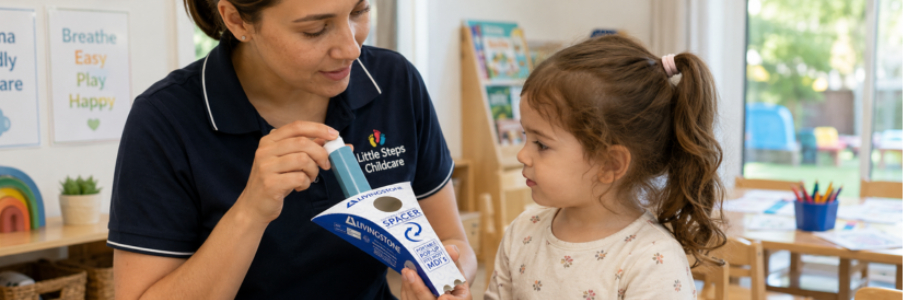
A spacer is a hollow chamber that attaches to a puffer, holding medication in suspension so a child can breathe it in gradually rather than needing to inhale at the exact moment of activation, which most young children cannot reliably do.
Without one, most of the dose settles in the mouth and throat before reaching the lungs. The Livingstone Flat Disposable Cardboard Asthma Spacer is a foldable, single-use option suited to childcare, removing any risk of cross-contamination and covering the common case where a child arrives without one from home.
Why Are Young Children More Vulnerable to Asthma Episodes in Childcare?
Children under five have airways proportionally smaller than those of older children and adults, so modest inflammation causes far greater obstruction relative to airway size, and frequent exposure to respiratory viruses in group care settings makes episodes more likely to occur.
Young children also cannot always describe what they feel. A child may not report chest tightness in those terms; instead, they may simply go quiet, slow down, or withdraw from play. Recognising these behavioural changes falls to the educators who spend the day with them.
What Are the Warning Signs of Asthma Childcare Educators Should Recognise?
Warning signs include a cough worsening overnight or after activity, an audible wheeze, rapid or shallow breathing, visible effort at the neck or ribs, unusual paleness or withdrawal from play, and complaints of stomach ache that young children often use to describe chest discomfort.
- A cough that worsens at night, early morning, or after physical activity
- A whistling or wheezing sound on breathing out
- Rapid or shallow breathing out of proportion to activity level
- Visible effort when breathing, such as skin pulling at the neck or ribs
- Unusual paleness, quietness or reluctance to join physical play
Documenting these observations with dates and circumstances builds an accurate picture that supports families and healthcare providers in managing the condition.
How Should Childcare Educators Respond When a Child Has an Asthma Attack?
Sit the child upright, stay calm, administer four puffs of reliever medication through a spacer, wait four minutes and reassess, repeat once if needed, and call an ambulance immediately if there is no improvement after the second round or the child is worsening.
This sequence follows the Asthma Australia four-step first aid plan. Do not lie the child down, as this restricts the diaphragm and worsens breathlessness. Once stable, notify the family and record the episode in full, including time, symptoms, medication given and outcome.
Every child with known or suspected asthma should have a current, doctor-signed Asthma Action Plan on file and immediately accessible to all educators, specifying triggers, medications and the threshold for calling emergency services.
How Can Childcare Services Build a Culture of Asthma Preparedness?
A prepared centre trains all staff in inhaler and nebuliser technique, reviews each child’s Asthma Action Plan at intake and after every update, keeps equipment in consistent, accessible locations, and rehearses the response as often as anaphylaxis or evacuation drills.
Equipment alone does not protect children; staff who know how to use it do. Scenario-based practice with the nebuliser and spacers builds confidence, so that when a real episode occurs, the response is calmer and more accurate. Families notice when a service can explain exactly where equipment is kept and how staff are trained to use it.
A cough at morning drop-off is easy to set aside. For a child whose airways are sensitive and still developing, that cough can become a wheeze by lunchtime and a breathing emergency by afternoon. Educators who understand this progression, and who are equipped and trained to act without hesitation, are in the strongest position to respond.
References
- Asthma Australia (2024) Asthma First Aid.
- Australian Institute of Health and Welfare (2023) Asthma.