Why are Teale uterine forceps essential for gynaecological procedures?
Teale uterine forceps play an important role in gynaecological procedures by enabling clinicians to securely grasp, retract, and stabilise uterine tissue while maintaining precise control throughout treatment. To support these clinical demands, Livingstone Teale Uterine Forceps are engineered to deliver reliable performance across a range of surgical and diagnostic applications. This guide examines their purpose, common uses, and design characteristics that make them a preferred choice for healthcare professionals.
What Are Uterine Forceps and What Are They Used For?
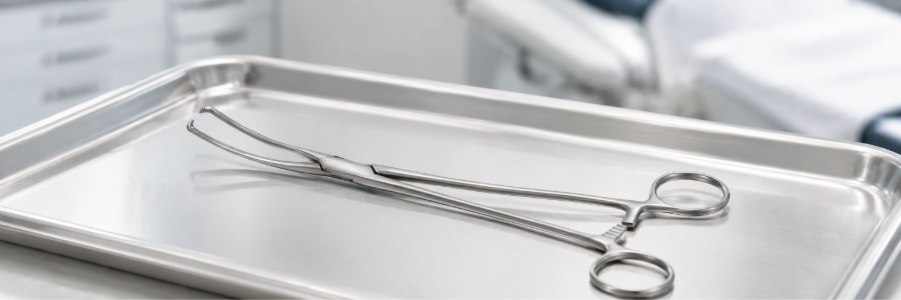
Uterine forceps, also known as teale tissue forceps or vulsellum forceps, are long-handled, ringed surgical instruments designed specifically for grasping, holding, and manipulating uterine tissue during gynaecological procedures. Their design prioritises secure tissue grip combined with controlled handling, allowing the clinician to retract, stabilise, or reposition the uterus or cervix without losing purchase on the tissue.
Teale tissue forceps are characterised by inwardly curved jaws fitted with interlocking teeth, typically in a 3 x 4 configuration. This tooth pattern creates a firm, multi-point grip across the tissue surface, distributing holding force evenly rather than concentrating it at a single point.
What Procedures Are Uterine Forceps Used In?
Uterine forceps are used across a broad range of gynaecological and obstetric procedures where control of uterine and cervical tissue is required.
- Hysterectomy procedures, where forceps are used to retract the uterus, fallopian tubes, and blood vessels to provide clear surgical access
- Dilation and curettage (D&C), where the cervix requires stabilisation before instrumentation
- Intrauterine device (IUD) insertion and removal, where uterine positioning is critical to successful placement
- Endometrial biopsy procedures requiring cervical traction and stabilisation
- Hysteroscopy, where uterine positioning assists with instrument insertion and visualisation
- Obstetric procedures requiring manipulation or stabilisation of uterine tissue
What Makes the Teale Design a Preferred Choice for Gynaecological Forceps?
The Teale design has remained a standard in gynaecological instrument sets for good reason. Its specific engineering decisions address the practical demands of uterine tissue handling in a way that more generic forceps cannot match.
3 x 4 Tooth Configuration for Multi-Point Grip
The 3 x 4 tooth pattern on Teale tissue forceps creates seven interlocking contact points across the tissue surface when the jaws are closed. This distribution of grip prevents the instrument from rotating or slipping during traction, which is particularly important when applying sustained pulling force during hysterectomy or when stabilising the cervix against patient movement during a conscious procedure.
Ratchet Locking Mechanism for Hands-Free Holding
Teale forceps feature a ratchet locking system on the shafts that allows the instrument to be set and held in a closed position without the clinician needing to maintain continuous manual pressure. This self-locking function is valuable in procedures where tissue needs to be held in position while the practitioner uses both hands for another task.
24cm Length for Deep Surgical Access
At 24cm, Teale uterine forceps provide the reach needed for both vaginal and abdominal approaches without requiring the surgeon to work at an awkward angle. The length keeps the practitioner’s hands clear of the surgical field while maintaining full control of the instrument tip.
What Should Clinicians Look for in Professional Surgical Instruments?
The performance of any professional surgical instrument is determined by three interconnected factors: material quality, manufacturing precision, and maintenance suitability.
Surgical-Grade Stainless Steel Construction
High-quality surgical instruments are manufactured from surgical-grade stainless steel, which provides the corrosion resistance, surface hardness, and dimensional stability required for repeated sterilisation cycles. Inferior steel alloys are prone to pitting, surface staining, and hinge wear that compromise instrument function and create surfaces where microorganisms can persist despite sterilisation.
Autoclave Compatibility and Sterilisation Durability
Reusable surgical instruments must withstand repeated autoclave sterilisation cycles without degradation. Steam sterilisation at 134 degrees Celsius under high pressure is the standard method for gynaecological instruments in Australian clinical settings, consistent with AS/NZS 4187 guidelines. Instruments should always be autoclaved in an open, unlocked position to allow steam penetration through all joint surfaces.
Precision Jaw Alignment
The teeth of a uterine forceps must close in precise alignment to create the interlocking grip they are designed for. When evaluating a new instrument, clinicians should close the tips against each other and check that opposing teeth mesh cleanly without lateral offset. Any gap or misalignment at the tip is grounds for rejection.
The Livingstone Teale Uterine Forceps
The Livingstone Teale Uterine Forceps is a professional surgical instrument constructed for use in gynaecological procedures requiring secure uterine tissue grasping and manipulation. The 3 x 4 toothed jaw configuration provides a firm, slip-resistant grip across a broad tissue surface area, while the 24cm shaft length delivers the reach needed for both vaginal and abdominal procedure access.
Constructed from surgical-grade stainless steel, this instrument is designed for repeated autoclave sterilisation and long-term clinical use. For a full range of scissors, forceps, and surgical instruments, explore the Livingstone Scissors and Forceps Collection.
How Should Uterine Forceps Be Cared for Between Procedures?
- Rinse instruments immediately after use with lukewarm water to prevent blood and tissue from drying onto joint surfaces
- Clean using an enzymatic instrument detergent before sterilisation, paying particular attention to the tooth pattern and ratchet mechanism
- Lubricate hinges and ratchet mechanisms with instrument-grade lubricant after cleaning and before autoclaving
- Autoclave in an open, unlocked position at 134 degrees Celsius for a minimum of three to five minutes
- Inspect jaw alignment, ratchet engagement, and surface condition after each sterilisation cycle
- Store in a dry, dedicated instrument tray or sterilisation pouch away from other instruments
Frequently Asked Questions
What is the difference between uterine forceps and vulsellum forceps?
The terms are often used interchangeably in clinical settings. Vulsellum forceps is a broader category name for toothed grasping forceps used on the uterus or cervix, while uterine forceps describes the functional application. The Teale design is a specific subtype, distinguished by its particular jaw curve, 3 x 4 tooth configuration, and ratchet locking system.
How many sterilisation cycles can a quality uterine forceps withstand?
A well-maintained surgical-grade stainless steel instrument can withstand hundreds of autoclave sterilisation cycles when cleaned, lubricated, and processed correctly. The limiting factors are typically hinge wear, tooth wear from repeated interlocking, and surface corrosion resulting from inadequate drying after sterilisation.
When should uterine forceps be replaced?
Uterine forceps should be retired from use when jaw alignment has drifted and teeth no longer interlock cleanly, when the ratchet mechanism does not hold securely under load, when pitting or corrosion is visible on any surface, or when the hinge shows excessive play that reduces control of the jaw tips.
Instrument Quality Is a Clinical Decision, Not Just a Procurement One
The instruments in a procedure room are not background equipment. They are active participants in the outcome of every procedure. For uterine forceps, the difference between a well-manufactured professional surgical instrument and an inferior alternative is felt in every procedure: in the security of the grip, the smoothness of the ratchet, and the confidence of the clinician using them.
Selecting the right teale tissue forceps is not simply a matter of ticking a box on a procurement list. It is a decision that directly supports the quality and safety of gynaecological care.
References
MediTools Pty Ltd 2025, Step-by-step: sterilising and maintaining surgical-grade stainless steel instruments, MediTools, viewed June 2026.
MES Australia 2025, Best practices for sterilising surgical instruments in autoclaves, MES Australia, viewed June 2026.
Standards Australia 2023, AS/NZS 4187:2014 reprocessing of reusable medical devices in health service organisations, Standards Australia, viewed June 2026.
Surtex Instruments 2026, Teale tenaculum forcep, Surtex Instruments, viewed June 2026.