Choosing the correct dental impression tray is essential for producing accurate edentulous impressions. A properly fitted Asa dental impression tray supports even material distribution, captures critical anatomical structures and improves denture fit, helping reduce remakes while supporting predictable prosthodontic outcomes.
Every complete denture begins with an accurate impression. Before impression material is mixed or the laboratory process begins, selecting the correct dental impression tray plays an important role in capturing the patient’s oral anatomy and supporting a well-fitting prosthesis.
Unlike dentate impressions, edentulous impressions rely entirely on accurately recording the residual ridge, vestibule and surrounding soft tissues. An impression tray that is too small, too large or poorly suited to the patient’s anatomy can affect border extension, impression stability and the overall fit of the final denture.
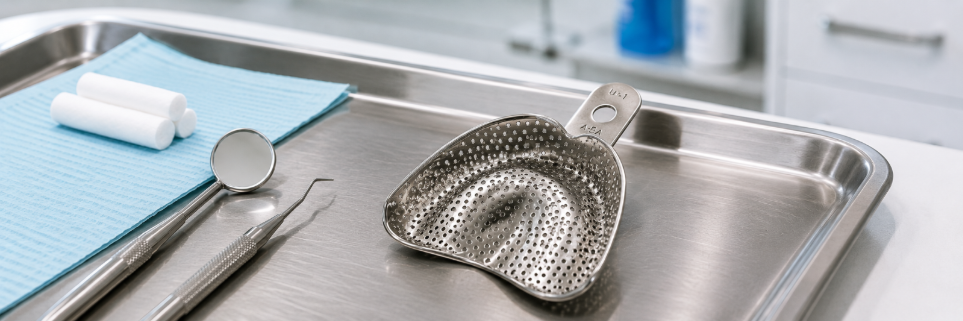
Using a purpose-designed Asa Dental Impression Tray helps clinicians achieve more predictable impressions while supporting efficient workflows in everyday practice. Livingstone offers a comprehensive range of reusable stainless steel impression trays, including the upper edentulous impression tray no 61, designed to deliver reliable performance across prosthodontic procedures. For additional impression solutions, explore the Dental Impression Trays collection.
Accurate Impression Tray Selection for Complete Dentures
Successful dentures depend on impressions that accurately reproduce the patient’s oral anatomy.
For fully edentulous patients, there are no remaining teeth to provide retention or positional reference points during the impression process. Instead, the impression tray must support even distribution of impression material while accurately capturing the ridge, sulcus depth and functional border tissues.
Choosing the correct tray helps reduce distortion, improves impression stability and minimises the risk of denture remakes caused by inaccurate initial impressions.
How are edentulous impression trays different from dentate trays?
Edentulous impression trays are specifically designed to follow the contours of a toothless arch rather than an arch containing natural teeth.
Compared with dentate trays, they typically feature:
- Deeper flanges to capture vestibular anatomy
- A smoother profile that follows the residual ridge
- Improved border extension
- Shapes designed specifically for fully edentulous patients
As alveolar ridges gradually resorb following tooth loss, a standard dentate tray may not provide adequate coverage or support for impression materials.
Selecting an impression tray designed specifically for edentulous cases helps improve the accuracy and consistency of complete denture impressions.
What factors affect impression accuracy?
Several factors work together to determine the quality of an edentulous impression.
Select the correct tray size
Choosing the appropriate tray size allows impression material to remain evenly distributed throughout the arch.
A tray that is too small may compress tissues or fail to capture border anatomy, while an oversized tray may prevent complete seating or create uneven material thickness.
Using the correct Asa dental impression tray helps provide more consistent material support and improved impression accuracy.
Capture adequate border extension
Border extension should accurately record the functional vestibule without causing discomfort or over-extension.
Trial fitting the tray before loading impression material allows clinicians to confirm proper adaptation before taking the final impression.
Improve material retention
Tray design also influences impression stability.
Perforated trays allow impression material to mechanically lock through the perforations, helping reduce separation during removal and improving impression integrity.
Why choose a perforated dental impression tray?
Perforated impression trays are widely used with alginate and other impression materials because they improve mechanical retention throughout the procedure.
The perforations help:
- Secure impression material within the tray
- Reduce material separation during removal
- Improve impression stability
- Support more accurate clinical results
The upper edentulous impression tray no 61 combines a perforated stainless steel design with excellent rigidity, making it a practical choice for clinicians seeking predictable impressions during complete denture procedures.
How do you select the right upper edentulous impression tray?
Choosing the correct tray involves more than simply selecting the closest size.
Assess the patient’s anatomy
Evaluate arch width, ridge height and palate depth before selecting an appropriate tray.
Trial fit before loading
Always seat the tray first to confirm proper extension and patient comfort before introducing impression material.
Choose a rigid stainless steel tray
Rigid metal trays maintain their shape throughout impression taking, helping minimise distortion while supporting accurate prosthodontic outcomes.
Keep a complete range available
Maintaining multiple tray sizes within the practice allows clinicians to accommodate different arch shapes without compromising impression quality.
Small improvements during tray selection often reduce repeat impressions and improve overall clinical efficiency.
Why do reusable stainless steel trays remain a popular choice?
Reusable stainless steel impression trays continue to be widely used because they combine durability, rigidity and long-term clinical performance.
A quality reusable tray offers:
- Excellent resistance to distortion
- Consistent support for impression materials
- Compatibility with validated cleaning and sterilisation procedures
- Long service life in busy dental practices
When practices buy dental impression trays online, selecting reusable stainless steel designs provides a practical long-term solution that supports both workflow efficiency and sustainable instrument management.
What infection prevention practices should dental clinics follow?
Reusable impression trays should be cleaned, disinfected and reprocessed between every patient in accordance with the practice’s validated infection prevention protocols.
Regular inspection for wear, distortion or damage also helps maintain impression accuracy while supporting patient safety.
Following documented instrument reprocessing procedures protects both clinicians and patients while extending the service life of reusable dental instruments.
Supporting accurate impressions every day
Producing accurate edentulous impressions depends on consistent clinical techniques supported by appropriate instruments. Selecting the correct tray size, confirming proper adaptation, using a perforated design and following validated reprocessing procedures all contribute to more predictable prosthodontic outcomes.
A quality Asa dental impression tray, including the upper edentulous impression tray no 61, helps clinicians produce stable, accurate impressions while supporting efficient workflows throughout the practice. When combined with appropriate impression materials and documented infection prevention procedures, the right impression tray provides a reliable foundation for successful complete denture treatment.
Explore the Livingstone International Dental Impression Trays collection for reusable stainless steel impression trays designed to support accurate impressions, efficient workflows and dependable clinical performance.
References
Australian Dental Association. (2024). ADA Guidelines for Infection Prevention and Control (5th ed.).
National Health and Medical Research Council. (2019). Australian Guidelines for the Prevention and Control of Infection in Healthcare.
Standards Australia. (2023). AS 5369:2023 Reprocessing of Reusable Medical Devices and Other Devices in Health and Non-Health Related Facilities.