Filter paper is an essential consumable in school science laboratories. Understanding the differences between slow, medium, and fast filter papers helps ensure accurate filtration, efficient practical work, and reliable experimental results. Choosing the wrong grade can slow down an experiment, compromise results, or allow particles to pass through that should be retained. This guide explains the key differences between each type and how to select the most suitable filter paper for different school science applications.
What Is Filter Paper and Why Does It Matter in School Science?
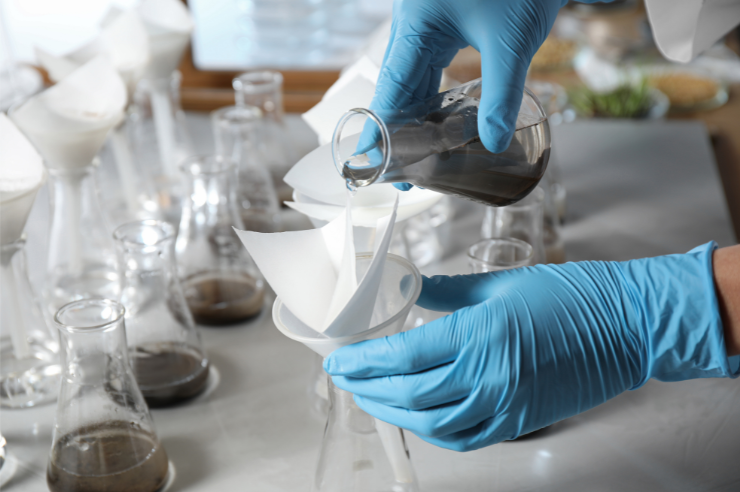
Filter paper is a semi-permeable material used to separate solids from liquids during laboratory filtration. It is widely used in Australian school science practicals, including soil analysis, solution purification, and chemistry experiments.
In Australian school science curricula, filtration is a core practical skill taught across Years 7 through 10 and beyond. Students use filter paper when separating sand from water, purifying solutions, analysing soil samples, and conducting quantitative chemistry experiments. Selecting the correct grade is not a minor detail; it directly affects the accuracy and efficiency of the experiment.
What Are the Three Main Types of Filter Paper?
Filter papers are classified broadly by their pore size, which determines both the size of particles they retain and the speed at which liquid passes through them. The three main categories used in school laboratories are slow, medium, and fast filter papers.
Slow Filter Paper: High Retention for Fine Particles
Slow filter papers have the smallest pore sizes, typically ranging from 2 to 3 micrometres. This tight structure means they are excellent at retaining the finest precipitates, including barium sulphate, calcium oxalate, and other materials produced in gravimetric analysis.
Because the pores are so small, liquid takes longer to pass through. This reduced flow rate is a trade-off that scientists and students accept when precision matters more than speed. Slow filter papers are often referred to as quantitative or ashless grades, meaning they leave very little residue when incinerated, making them suitable for experiments requiring accurate measurement of dry mass.
Common applications in school laboratories include:
- Quantitative gravimetric analysis in senior chemistry
- Separating very fine crystalline precipitates from solution
- Experiments requiring highly accurate mass measurements
Medium Filter Paper: The All-Purpose Laboratory Choice
Medium filter papers occupy the middle ground, offering a balance between retention and flow rate. With pore sizes typically ranging from 8 to 12 micrometres, they retain most general precipitates while allowing liquid to flow through at a moderate speed.
Typical uses include:
- Routine filtration tasks in Year 7 to 10 science
- Separating sand, charcoal, or copper sulphate crystals from water
- General qualitative analysis in chemistry practicals
- Filtering soil samples in environmental science experiments
Fast Filter Paper: High Flow Rate for Coarse Filtrations
Fast filter papers have the largest pore sizes, often ranging from 20 to 25 micrometres or greater. They allow liquid to pass through rapidly, making them ideal when speed is a priority and the particles being removed are large enough to be retained by a coarser structure.
Fast grades are ideal for high-volume filtration and coarse particle separation.
Common applications include:
- Rapid separation of coarse soil or sand particles
- Environmental monitoring and field sampling
- Pre-filtering solutions before a finer filtration step
- Food science experiments requiring rapid liquid separation
Typical grades include Whatman Grade 4 and Grade 617. These are less commonly used in standard school curricula but are valuable for specific experimental contexts.
How Do You Choose the Right Filter Paper for Your Experiment?
Selecting the correct filter paper is important for achieving accurate and reliable filtration results. The most suitable grade depends on the size of the particles being separated, the required filtration speed, and the objectives of the experiment.
- Slow filter paper is best for fine precipitates and quantitative analysis where maximum particle retention is needed
- Medium filter paper is suitable for most school laboratory experiments, providing a balance between filtration speed and retention
- Fast filter paper is ideal for coarse particles and applications where rapid filtration is required.
- For experiments involving dry mass measurements or gravimetric analysis, use a quantitative or ashless filter paper
- Always ensure the filter paper matches the size of your funnel or filtration apparatus to prevent bypass and maintain accurate results
Filter Paper Storage and Laboratory Preparation
Filter paper has a shelf life and should be stored flat, away from moisture and direct sunlight, to preserve its structural integrity.
When restocking, consider stocking a range of grades so teachers can select the appropriate paper for each lesson without delays. A well-stocked laboratory kit typically includes at least one slow quantitative grade, one general medium grade, and one fast grade for coarser tasks.
For a comprehensive selection of quantitative and qualitative filter papers for Australian school science, visit Livingstone International’s quantitative and qualitative filter paper collection, which includes a variety of grades suited to both primary and secondary laboratory programmes.
Are There Any Safety Considerations When Using Filter Paper in School Labs?
Filter paper itself is a low-risk consumable, but laboratory safety practices always apply. Students should:
- Handle filter paper with clean, dry hands or tongs to avoid contamination
- Avoid touching the central area of the paper where filtration occurs
- Fold filter paper correctly to ensure it seats flush with the funnel
- Dispose of used filter paper appropriately, especially if it contains chemical residues
Teachers and laboratory technicians should refer to the relevant state safety guidelines and Australian school science safety frameworks when planning practical activities involving filtration.
Frequently Asked Questions about Filter Paper in School Laboratories
What is the difference between qualitative and quantitative filter paper?
Qualitative filter paper is used for general separation tasks where the result is observed rather than measured. Quantitative (ashless) filter paper is used when the filtered solid needs to be weighed accurately, as it leaves minimal residue after incineration.
What filter paper grade is best for general school science?
For most Year 7 to 10 experiments, a medium grade such as Livingstone Grade 1 or an equivalent is the most versatile choice. It offers reliable particle retention and an acceptable flow rate for classroom use.
Conclusion
Understanding the differences between slow, medium, and fast filter papers is an essential part of laboratory literacy for Australian school students and teachers alike. By selecting the correct grade for each experiment, you can improve the accuracy of results, manage class time efficiently, and build strong practical science skills across a wide range of laboratory activities.
Selecting the appropriate filter paper is a simple but important step in achieving accurate, efficient, and reliable laboratory results.
References
1. NSW Education Standards Authority (NESA) 2023, Science K-10 Syllabus, NESA, Sydney, viewed May 2025, < https://curriculum.nsw.edu.au/learning-areas/science>.
2. Royal Australian Chemical Institute (RACI) 2023, Safe Laboratory Practices for Secondary Schools, RACI, Melbourne, < https://www.raci.org.au/resources/education-resources>