If materials had personalities, nichrome wire would be the reliable colleague who never complains, never overheats under pressure (quite literally) and quietly gets the job done in the background of half the appliances in your kitchen. It is not flashy. It does not glow with the same drama as a filament bulb or spark like a live circuit. But strip back a toaster, a hairdryer or a school physics kit, and there is a very good chance nichrome wire is doing the heavy lifting. This guide breaks down what nichrome wire is, why it behaves the way it does, and where it shows up across laboratories, classrooms and everyday appliances. If you are stocking a science lab and want to browse the wider school science lab physics range, or you already know exactly what you need and want to jump straight to searching for nichrome wire, both are useful starting points before diving into the detail below.
What Exactly Is Nichrome Wire?
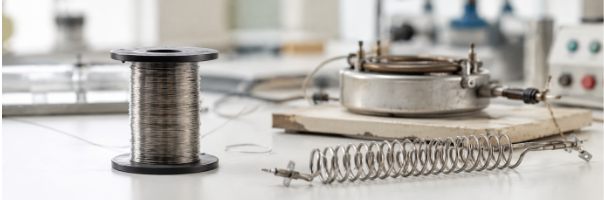
Nichrome is an alloy made primarily from nickel and chromium, usually in a ratio of around 80 percent nickel to 20 percent chromium, sometimes with a small amount of iron added depending on the grade. It was patented back in 1905 by Albert Marsh, making it one of the earliest engineered resistance heating alloys still in everyday use over a century later. Despite its age, nothing has come along to meaningfully replace it in most applications, which says a great deal about how well the original formula worked.
Why Does Nichrome Wire Get Hot When Other Wires Do Not?
This comes down to electrical resistance. Most metals, like copper, are excellent conductors precisely because they offer very little resistance to electron flow, which is why copper wiring stays cool. Nichrome is the opposite. Its atomic structure resists the flow of electric current, and that resistance converts electrical energy into heat. Run a current through a coil of nichrome wire and it glows red hot within seconds, all without melting, snapping or losing its shape.
Key Properties of Nichrome Wire
Heat Resistance
Nichrome can withstand sustained temperatures up to around 1,200°C, with some formulations rated even higher. This is what allows it to survive being heated and cooled repeatedly, cycle after cycle, without breaking down.
Oxidation Resistance
When nichrome heats up, it forms a thin protective layer of chromium oxide on its surface. Rather than corroding away like many metals would at high temperature, this oxide layer shields the wire underneath, extending its working life considerably.
Non-Magnetic Behaviour
Nichrome does not respond to magnetic fields, which matters in applications where magnetic interference needs to stay off the table entirely.
Mechanical Strength and Ductility
Nichrome stays strong and workable even after extended use, meaning it can be wound into coils, shaped into elements and bent to fit a design without becoming brittle or prone to snapping.
Stable Electrical Resistance
Its resistance stays relatively consistent across a wide temperature range, which makes it dependable in situations where precise, predictable heat output really matters.
Where Is Nichrome Wire Actually Used?
In the Classroom and Laboratory
Nichrome wire shows up frequently in school science and physics settings, often used in flame tests to introduce a sample into a Bunsen flame without contaminating results, or as a component in simple circuits demonstrating resistance and heat conversion. Its non-reactive nature also makes it useful for transferring small samples between containers without interference.
In Everyday Appliances
Toasters, hairdryers, kettles and space heaters all rely on nichrome coils as their heating element. Next time toast pops up perfectly golden, there is a good chance a length of nichrome wire deserves at least partial credit.
In Industrial and Specialised Settings
Industrial furnaces, hot-wire foam cutters, 3D printer heating elements and even some aerospace de-icing systems all lean on nichrome’s combination of heat tolerance and reliability. It also appears in dental restorations and certain medical instruments, where corrosion resistance and predictable behaviour under heat are non-negotiable.
Choosing the Right Nichrome Wire for the Job
Not all nichrome wire is created equal. Gauge, or thickness, directly affects resistance and current handling, so thinner wire suits low-power educational demonstrations while thicker gauges are better suited to higher-current heating applications. Composition also varies slightly between grades, with some formulations favouring maximum corrosion resistance and others prioritising higher operating temperatures. Matching the wire to the application, rather than grabbing whatever is on hand, makes a genuine difference to performance and longevity.
A Quietly Essential Material
Nichrome wire will never be the star of a chemistry demonstration or the centrepiece of a science fair project, but it is one of those materials that keep everything else running smoothly in the background. From classroom flame tests to the toaster on your kitchen bench, its steady resistance to heat, corrosion and wear has earned it more than a century of continued use, and there is no sign of that changing any time soon.
References
ChemistryLearner, n.d. Nichrome Composition, Properties, Nichrome Wire, Uses, Price. Available at: https://www.chemistrylearner.com/nichrome.html (Accessed: 19 August 2026).
ScienceDirect, n.d. Nichrome: An Overview. Available at: https://www.sciencedirect.com/topics/materials-science/nichrome (Accessed: 19 August 2026).
Wikipedia, n.d. Nichrome. Available at: https://en.wikipedia.org/wiki/Nichrome (Accessed: 19 August 2026).