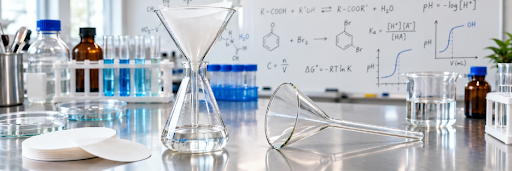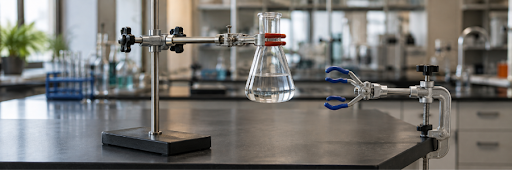
A filter funnel and a separating funnel might look similar sitting on a laboratory shelf, but they are built for entirely different jobs. One is designed to separate solids from liquids using filter paper, while the other separates two liquids of different densities using a stopcock. Choosing the wrong one can compromise results, waste reagents, and slow down workflow. This guide breaks down the practical differences, when to use each and what to look for when selecting laboratory glassware for your team.
What Is a Filter Funnel Used For?
A filter funnel is used to separate solid particles from a liquid or suspension by directing the mixture through filter paper into a collection vessel. It relies on gravity or vacuum to draw liquid through the paper while solids remain trapped, a process known as filtration.
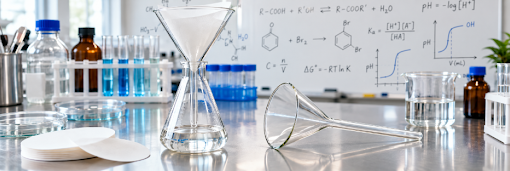
Filter funnels, sometimes called conical funnels, have a simple cone shape with a narrow stem. In practice, the technician folds filter paper into a cone, places it inside the funnel and pours the mixture through. The liquid, called the filtrate, passes through the paper and stem into a flask or beaker below, while solid residue collects on the paper. This is standard practice in microbiology, environmental testing, water analysis and general chemistry laboratories where separating precipitates or impurities from a solution is routine. A Livingstone borosilicate glass filter funnel is a practical choice for laboratories needing consistent, chemical-resistant equipment for daily filtration tasks.
What Materials Are Filter Funnels Made From?
Filter funnels are mostly made from borosilicate glass, though polypropylene and stainless steel versions exist for specific applications. Glass is favoured for its chemical resistance, transparency, and ability to withstand a wide range of solvents and cleaning methods.
Borosilicate glass funnels are widely used in healthcare, research and educational laboratories because they provide strong chemical resistance across many laboratory acids, solvents and aqueous solutions while remaining suitable for repeated heating and cleaning processes. Plastic funnels are lighter and less prone to breakage, which makes them suitable for teaching environments or fieldwork, but they are generally less resistant to certain chemicals and solvents. Stainless steel funnels can offer extreme durability, though their suitability and corrosion resistance depend on the grade of steel used and the specific chemicals or conditions involved, so compatibility should be confirmed for the intended application.
What Is a Separating Funnel Used For?
A separating funnel is used to separate two immiscible liquids, meaning liquids that do not mix, based on differences in their density. It has a pear or conical shape with a stopcock at the base that allows the denser liquid to be drained off while the lighter liquid remains in the funnel.
This process, known as liquid-liquid extraction, is widely used in organic chemistry, pharmaceutical preparation and environmental testing. A common example is separating an organic solvent layer from an aqueous layer after a chemical reaction. The mixture is added to the funnel, the stopper is inserted, and the funnel is inverted carefully and vented periodically to release pressure buildup before the layers are allowed to settle. Once separated, the stopcock is opened to drain the lower, denser liquid into a collection vessel, leaving the upper layer behind. A Livingstone glass separating funnel with a conical shape and glass stopcock supports controlled draining during liquid-liquid extraction procedures.
How Does a Separating Funnel Achieve Separation?
A separating funnel achieves separation through density differences and gravity settling, not filtration. The two liquids form distinct layers inside the funnel, and the stopcock allows precise, controlled draining of the lower layer without disturbing the upper one.
Unlike a filter funnel, there is no filter paper or medium involved. The technique depends entirely on the physical properties of the liquids and careful technique during shaking, venting, and settling. Venting is critical, particularly with volatile solvents, because pressure can build up inside the sealed funnel and cause the stopper to release unexpectedly. Safe handling of hazardous chemicals during this process is addressed in guidance from Safe Work Australia, which outlines risk controls for workplaces using hazardous substances and chemicals.
How Do the Separation Methods of These Two Funnels Compare?
The main difference is the separation method: a filter funnel separates solids from liquids using filter paper, while a separating funnel separates two liquids of different densities using a stopcock. They are not interchangeable and are used for distinct laboratory procedures.
A filter funnel is not designed for controlled liquid-liquid separation, because without a stopcock there is no way to drain one liquid layer away from the other with precision, even though liquid can still be poured or decanted through it. Conversely, a separating funnel is not designed to hold filter paper or trap solid particles efficiently, since its shape and stopcock mechanism are built for liquid drainage rather than filtration. Selecting the correct funnel for the task supports accurate results and reduces the risk of contamination or spillage.
When Should You Choose a Filter Funnel Over a Separating Funnel?
A filter funnel should be chosen when the task involves removing solid particles, precipitates or debris from a liquid sample through filtration. This includes routine filtration in chemistry, pathology-related laboratory preparation, water testing and sample preparation workflows where solids need to be retained while the liquid portion passes through the filter medium.
If the goal is to clarify a solution, isolate a precipitate or prepare a sample for further analysis, a filter funnel paired with the appropriate filter paper grade is often selected for the task. Technicians should also consider funnel diameter and stem length relative to the receiving vessel to avoid splashing or overflow.
When Should You Choose a Separating Funnel Over a Filter Funnel?
A separating funnel should be chosen when the task involves isolating two immiscible liquid phases, such as during solvent extraction or purification procedures. It is the appropriate tool whenever density-based liquid separation, rather than solid removal, is required in analytical chemistry, environmental testing or preparation workflows.
This includes extracting organic compounds from aqueous solutions, purifying reaction products or separating oil-based contaminants from water samples in environmental testing. Correct stopcock maintenance, including regular cleaning and lubrication where applicable, helps maintain a reliable seal and controlled drainage.
What Should You Consider When Choosing Between a Filter Funnel and a Separating Funnel?
Choosing between a filter funnel and a separating funnel depends on the separation task at hand, the chemical compatibility of the sample, and the condition of the glassware. Task type, solvent resistance and equipment integrity together determine which funnel will deliver safe, accurate results.
For filtration tasks, technicians should match filter paper grade to particle size and confirm the funnel diameter suits the receiving vessel to avoid overflow. For liquid-liquid extraction, stopcock size should match sample volume, and the seal should be checked for smooth, leak-free operation before use. In both cases, glassware condition matters: a chipped or cracked funnel can compromise a seal, contaminate a sample or fail under pressure. Guidance from Science ASSIST reinforces that damaged laboratory glass should be inspected and removed from circulation rather than risked in either procedure (Science ASSIST, 2025).
References
Safe Work Australia (n.d.) Hazardous chemicals. Available at: