Choosing the right laboratory flask might seem like a small decision, but it can significantly affect the accuracy, safety and efficiency of your work. Two of the most common vessels within any laboratory glassware collection are the flat-bottom flask and the round-bottom flask. While they may look similar at a glance, each is engineered for distinct applications, heating methods and stability requirements. Anyone comparing the two shapes side by side will usually find it helpful to browse a broader range of laboratory flasks first, to get a feel for how neck style, capacity and glass grade vary between designs. This guide breaks down the key differences to help researchers, educators and lab technicians select the right flask for their needs.
What Is a Flat-Bottom Flask Used For?
Flat-Bottom Flask Application and Benefits
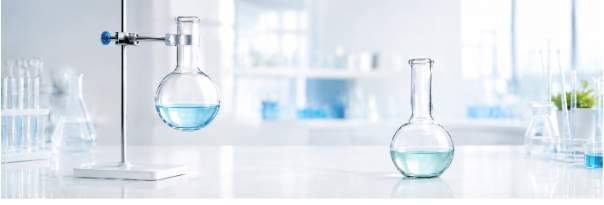
A flat-bottom flask, often called an Erlenmeyer or boiling flask depending on its neck shape, features a wide, level base that allows it to stand upright on a benchtop without additional support.
Key Characteristics
- Stable on flat surfaces without a stand or ring clamp
- Easy to fill, swirl and pour
- Suitable for mixing, titrations and general storage
- Typically made from borosilicate glass for chemical resistance
Flat-bottom flasks are a staple in general laboratory glassware collections because of their versatility. They are commonly used for titrations, sample preparation, mixing reagents and short-term storage of liquids. Their stability makes them ideal for everyday bench work where precision heating is not the primary concern.
The wide base also means the contents have a larger surface area exposed to air, useful when a reaction benefits from faster evaporation. This makes flat-bottom flasks a practical choice for culturing in microbiology, as well as for teaching environments where students are still building confidence handling glassware.
What Is a Round-Bottom Flask Used For?
Round-Bottom Flask Applications and Benefits
A round-bottom flask has a spherical base and no flat surface, meaning it requires a support stand, clamp or heating mantle to remain upright. This design is intentional, offering distinct performance advantages in specific applications.
Key Characteristics
- Even heat distribution across the entire vessel
- Withstands pressure changes and vacuum conditions
- Ideal for reflux, distillation and evaporation
- Reduces stress points that can lead to cracking under heat
Because heat spreads evenly across the curved surface, round-bottom flasks are the preferred choice for procedures involving sustained heating, boiling or rotary evaporation. They are widely used in organic chemistry, pharmaceutical research and any application requiring controlled thermal reactions.
The absence of flat surfaces or sharp corners also means there are fewer stress points where cracks can form, which matters most during rapid heating and cooling cycles. This is why round-bottom flasks are the standard vessel for reflux setups, where a solvent is continuously boiled and condensed back into the flask, sometimes for hours at a time. The narrow neck also allows secure attachment of condensers or thermometers, making these flasks well suited to multi-step synthesis.
Flat-Bottom vs Round-Bottom Flask: A Side-by-Side Comparison
| Feature | Flat-Bottom Flask | Round-Bottom Flask |
| Stability | Stands alone | Requires stand or clamp |
| Heat distribution | Uneven, prone to hot spots | Even, minimises stress |
| Best for | Mixing, titration, storage | Reflux, distillation, evaporation |
| Pressure tolerance | Lower | Higher |
| Common settings | Teaching labs, QC testing | Research labs, synthesis work |
Which Flask Should You Choose?
Choose a Flat-Bottom Flask If You Need To:
- Perform titrations or general mixing
- Store or transport liquid samples
- Work on a standard benchtop without support equipment
- Conduct routine quality control testing
Choose a Round-Bottom Flask If You Need To:
- Heat substances evenly over extended periods
- Perform distillation, reflux or rotary evaporation
- Work under vacuum or pressure-sensitive conditions
- Minimise the risk of thermal shock during reactions
Does Glassware Quality Matter as Much as Shape?
Yes. Regardless of shape, flask performance depends heavily on the quality of the glass itself. Borosilicate glass is the industry standard because it resists thermal shock, chemical corrosion and mechanical stress far better than standard glass, thanks to its low coefficient of thermal expansion. This matters just as much for a flat-bottom flask on a hotplate as it does for a round-bottom flask under reflux.
Wall thickness and manufacturing consistency also affect durability, as uneven walls create weak points around the neck and base even when the glass grade is high. When sourcing laboratory glassware, it is worth prioritising suppliers who provide certified, high-grade options with clear specifications on glass type, joint sizing and capacity tolerances.
Key Factors When Selecting Laboratory Flasks
Both flat-bottom and round-bottom flasks serve essential but different roles in the laboratory. Flat-bottom flasks offer convenience and stability for everyday mixing and storage, while round-bottom flasks are engineered for precision heating, distillation and reflux. Understanding these differences ensures safer handling, more accurate results and better equipment longevity, whether you are equipping a teaching lab, a research facility or a quality control department.
References
Chemistry LibreTexts, 2022. 1.4K: Reflux. Available at: https://chem.libretexts.org/Bookshelves/Organic_Chemistry/Organic_Chemistry_Lab_Techniques_(Nichols)/01:_General_Techniques/1.04:_Heating_and_Cooling_Methods/1.4K:_Reflux (Accessed: 19 August 2026).
John Morris Group Australia, n.d. Borosilicate Glass: Meaning, Types and Lab Uses. Available at: https://www.johnmorrisgroup.com/blog/what-is-borosilicate-glass-properties-types-lab-uses (Accessed: 19 August 2026).
Royal Society of Chemistry, n.d. Reflux and Distillation: Practical Videos. Available at: https://edu.rsc.org/practical/reflux-and-distillation-practical-videos-16-18-students/4012294.article (Accessed: 19 August 2026).
ScienceDirect, n.d. Borosilicate Glass: An Overview. Available at: https://www.sciencedirect.com/topics/materials-science/borosilicate-glass (Accessed: 19 August 2026).