Accurate temperature monitoring is a core component of health and safety practice in Australian childcare centres. Selecting an appropriate thermometer, and applying correct technique when taking a reading, directly affects the reliability of decisions made about a child’s wellbeing and any subsequent exclusion or parent notification.
Recent Australian testing found that several personal thermometers failed to meet their own accuracy claims, with some producing inconsistent results on repeat use (CHOICE, 2025). For a childcare service responsible for monitoring the health of children who cannot always articulate how they feel, this level of variability carries genuine operational and duty-of-care implications. Understanding which thermometer type suits each situation, and applying it correctly, is one of the most effective and low-cost measures a centre can implement.
What types of thermometers are used in childcare centres?
Australian childcare centres typically operate two thermometer types: digital clinical (probe) thermometers for accurate, confirmatory readings, and non-contact infrared thermometers for efficient, hygienic screening. Best-practice services maintain both, applying each device according to the situation it is designed to address.
Each device fulfils a distinct function within a centre’s daily health monitoring procedures. A digital probe thermometer, used under the arm, orally, or rectally depending on the child’s age, provides a precise reading and is the appropriate instrument when a decision must be made regarding a child’s exclusion or collection. A non-contact infrared thermometer scans the forehead or temple from a short distance, returning a reading within seconds without physical contact, making it suitable for efficient screening across a room of children.
What is a digital clinical thermometer used for in childcare?
A digital clinical thermometer provides the most accurate body temperature reading available outside a hospital setting and is used to confirm results before a centre plan regarding a child’s exclusion or collection. It is applied under the arm, orally, or rectally depending on the child’s age.
As a probe device measures temperature directly rather than estimating it from surface heat, it remains the benchmark instrument for accuracy in a childcare setting. The Livingstone Digital Fast Reading Clinical Thermometer incorporates a child-safe battery cover and a waterproof body, both relevant considerations in an environment where hygiene standards and supervision of small children are ongoing requirements. Centres are advised to maintain at least one probe thermometer per room so that a borderline infrared result can be confirmed without delay.
What is a non-contact infrared thermometer used for in childcare?
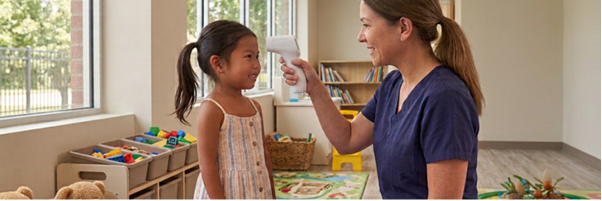
A non-contact infrared thermometer is used for efficient, hygienic first-pass screening across a childcare room, particularly during periods of heightened respiratory illness. It scans the forehead or temple from a short distance without physical contact, reducing the risk of transmitting pathogens between children through shared equipment.
Efficiency and hygiene make infrared devices a practical option for a centre managing multiple children concurrently. The Livingstone Non-Contact Infrared Thermometer returns a reading within seconds and, as it does not contact the skin, reduces the risk of cross-contamination between checks. It should be applied as a screening step, with any atypical result verified using a digital clinical thermometer prior to a final decision.
Why does thermometer accuracy matter in a childcare setting?
Thermometer accuracy is critical because a centre may take dozens of readings each day across multiple rooms and staff members, and a device that drifts by even half a degree can result in a child being excluded unnecessarily or, more seriously, a genuine fever going undetected.
Unlike a domestic setting in which a single adult monitors a single child, a childcare centre operates at considerably greater scale and with correspondingly higher risk. An inaccurate low reading may expose a room of children with developing immune systems to an infectious illness, while an inaccurate high reading disrupts a family’s arrangements and diverts a rostered educator from other responsibilities. Relying on a single low-cost device for every scenario is not considered good practice. Infrared readings serve as an effective initial check, but any result that appears unusually high or low should be verified with a digital clinical thermometer prior to a decision regarding exclusion.
What should childcare centres look for when selecting a thermometer?
Childcare centres should select purpose-built thermometers designed for use with infants and young children, and always follow the manufacturer’s instructions to obtain a reliable reading. Mercury thermometers are no longer recommended in any setting due to the poisoning risk associated with breakage.
Not every thermometer on the market is designed with a childcare environment in mind, and following the manufacturer’s instructions is essential to obtaining a reliable reading (healthdirect Australia, 2026). Centres are advised to select equipment built for repeated use across multiple children, with features such as a durable, wipeable housing and, for probe devices, a child-safe design. Under the National Quality Standard, services are also required to manage illness and infection control with consistency, and selecting reliable, purpose-built equipment forms an integral part of that obligation.
How should educators take an accurate temperature reading?
Educators obtain the most accurate reading by allowing an appropriate interval after food or activity, selecting the correct method for the child’s age, following the manufacturer’s specified distance and timing, and recording each result immediately alongside the time and method used.
The following procedure is recommended to reduce the likelihood of an inaccurate reading:
- Allow at least twenty minutes after a child has eaten, consumed a hot drink, or been active outdoors before taking a reading.
- Select the method appropriate to the child’s age, underarm for infants, oral for older children who can safely retain a thermometer in place.
- Position an infrared thermometer at the exact distance specified in the manufacturer’s instructions, typically one to three centimetres from the skin.
- Leave a digital probe thermometer in place until it signals completion rather than removing it prematurely.
- Record the reading immediately, together with the time and method used, to enable tracking of any pattern across the day.
- Clean the thermometer between each child using warm soapy water or an alcohol wipe to prevent cross-contamination.
Where a reading is inconsistent with a child’s observed behaviour, a second reading should be taken using a digital clinical thermometer before any decision is made.
Which thermometer should a childcare centre invest in?
Best-practice centres invest in both a non-contact infrared thermometer for efficient daily screening and a digital clinical thermometer for confirming any reading of concern, rather than relying on a single device for every situation.
Maintaining both device types ensures no room is dependent on a single tool, regardless of which educator is rostered on a given day. Correct equipment, supported by clear staff protocols and regular training, constitutes a genuine safeguard for every child in the centre and provides parents with visible assurance that health monitoring is managed to a consistent, professional standard.
References
- CHOICE (2025) How accurate is your personal thermometer?. CHOICE, viewed 3 July 2026,
- Healthdirect Australia (2026) Types of thermometer for fever, Australian Government, viewed 20 July 2026.