A wash bottle provides controlled dispensing, while a beaker provides a practical vessel for mixing, transferring and approximate measurement. Practical science lessons rely on equipment that supports consistent, controlled handling throughout an experiment.
A labelled wash bottle and a low-form graduated beaker are familiar laboratory tools used for everyday tasks such as dispensing, rinsing, mixing, transferring and estimating liquid volumes. When students understand the purpose of each item and use it correctly, these simple tools can support safer handling, more consistent practical techniques and a better-organised school science environment.
Why Are Wash Bottles and Beakers Essential in Science Labs?
Wash bottles and beakers are useful in practical science because they support two different liquid-handling tasks. A wash bottle provides controlled dispensing of an appropriate liquid, while a graduated beaker provides a vessel for mixing, transferring and estimating volume. Learning when to use each item helps students develop appropriate laboratory technique.
Hands-on science depends on students being able to trust their equipment. A wash bottle allows a fine, directed stream of water or other appropriate liquids to be controlled through hand pressure, while a beaker provides a stable, marked vessel for mixing and approximate measurement. Together, they support two of the most common tasks in practical science: dispensing liquid and containing it. When either item is unavailable or unsuitable for the task, students may need to rely on less appropriate alternatives, which can affect consistency, accuracy and safety, especially in schools running equipment across hundreds of uses per term.
How Do Wash Bottles Help Control Liquid Dispensing?
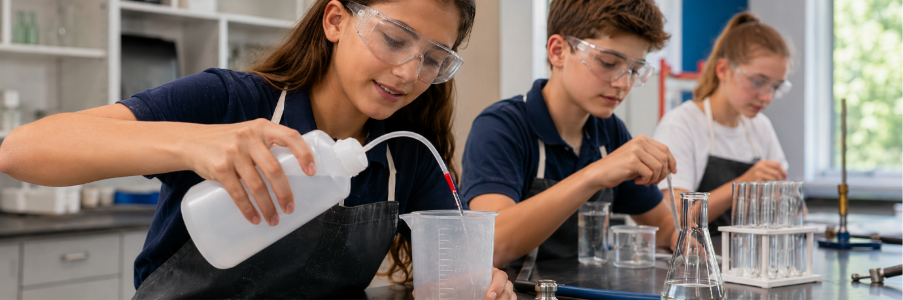
Wash bottles help control liquid dispensing by producing a fine, directed stream that can be controlled with hand pressure instead of pouring from an open container. This can help reduce spillage and unnecessary liquid use while giving students greater control during practical tasks.
The narrow dispensing tip and squeezable LDPE construction of a wash bottle provide greater control than pouring from an open container. This is particularly useful during rinsing or transfer steps, where a suitable rinse liquid can be used to wash material remaining on vessel walls into the receiving vessel. A clearly labelled wash bottle helps students identify its intended contents and reduces the risk of selecting the wrong bottle during practical activities.
Why Are Beakers Used for Mixing and Measuring?
Beakers are used for mixing and measuring because their wide mouths allow safe stirring and pouring, while graduated markings give students an immediate visual reference for approximate volume. A durable, lightweight construction also makes them practical for repeated handling in a busy classroom.
A low-form graduated beaker made from polypropylene offers a lightweight, breakage-resistant alternative to traditional glassware. This can help reduce the risks and disruption associated with broken glassware in classroom environments. The spout supports controlled pouring into other vessels, reducing spillage during transfers. Graduated markings are not intended for precision measurement the way a volumetric flask is, but they provide a useful visual reference when approximate volume estimation is sufficient, while also being durable for the wear and tear of regular student use.
When Should Students Use a Wash Bottle or Beaker?
Students should use a wash bottle whenever a liquid needs to be dispensed in small, controlled amounts, such as rinsing residue from equipment or adding a reagent gradually. A beaker should be used whenever a liquid needs to be mixed, transferred, or measured approximately before further use.
These two items are often used in sequence rather than in isolation. A student might use a beaker to hold and mix a solution, then use a wash bottle to rinse any remaining material from the beaker walls during transfer, helping minimise residual loss. The beaker’s lightweight, breakage-resistant construction makes it well suited to room-temperature mixing and transfer tasks, while the wash bottle handles the finer, controlled dispensing that mixing alone cannot achieve. Teaching students when to reach for each item, rather than treating them as interchangeable, builds procedural discipline that carries into later, more advanced practical work.
How Does the Right Lab Equipment Improve Science Activities?
The right lab equipment can improve science activities by helping reduce errors, cutting down on lesson time lost to spills or breakages, and giving students consistent, repeatable tools that build confidence in practical technique. Reliable equipment also supports safer classroom management for teachers overseeing multiple groups at once.
Equipment choice affects far more than the immediate task at hand. A wash bottle that dispenses unevenly or a beaker prone to cracking under regular handling introduces variables that have nothing to do with the science being taught, forcing teachers to troubleshoot equipment rather than concepts. Consistent, well-maintained laboratory equipment can support science inquiry skills outlined in the Australian Curriculum by helping students develop safe and systematic practical techniques (Australian Curriculum, Assessment and Reporting Authority, n.d.). Equipment selection should form part of broader laboratory risk management. WorkSafe Queensland also emphasises appropriate chemical labelling, access to safety data sheets, suitable storage, segregation and spill controls when hazardous chemicals are used in laboratories. (WorkSafe Queensland, n.d.).
Wash bottles and beakers may be small items on a much longer equipment list, but their reliability shapes the everyday experience of practical science for every student in the room. Choosing well-made, purpose-built versions of both is a straightforward way to support safer, more consistent, and more engaging science lessons.
References
Australian Curriculum, Assessment and Reporting Authority (n.d.) Science. Available at: https://www.australiancurriculum.edu.au/curriculum-information/understand-this-learning-area/science (Accessed: 20 August 2026).
WorkSafe Queensland (n.d.) Laboratories. Available at: https://www.worksafe.qld.gov.au/safety-and-prevention/hazards/hazardous-chemicals/specific-hazchem-workplaces/laboratories (Accessed: 20 August 2026).