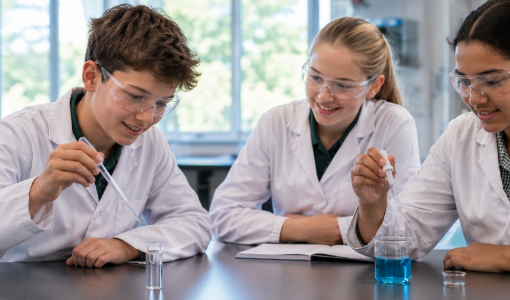
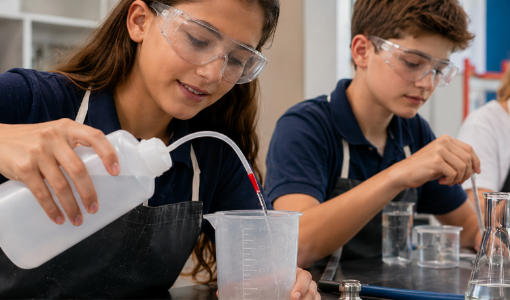
Practical chemistry becomes easier to understand when students can connect an invisible chemical property with a result they can see. Universal pH Indicator Strips Litmus Paper, pH 0 to 14 with Colour Chart and Citric Acid Anhydrous, Laboratory Grade, 500g provide a straightforward pairing for exploring acidity, colour change and pH in school science.
Citric acid anhydrous is supplied as colourless translucent crystals or white powder and is soluble in water. Universal pH indicator strips are designed to test solutions across pH 0 to 14. Used together, they help students move from observing a colour response to explaining what that response means chemically.
Why Are Litmus Paper and Citric Acid Useful in School Science?
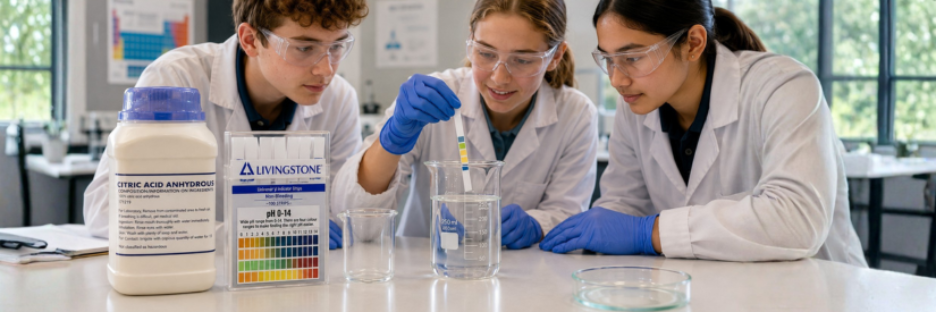
Litmus paper and citric acid are useful in school science because they turn acid-based theory into an observable experiment. Citric acid provides a familiar acidic substance, while universal pH indicator strips provide a colour-based estimate of pH, helping students connect chemical behaviour with measurement and evidence.
Students are not simply told that citric acid is acidic. They can test a prepared solution, observe the indicator response, and compare the colour pattern with a reference scale. This also introduces the difference between identifying acidity and estimating its degree. Traditional red or blue litmus paper mainly identifies whether a solution is acidic or alkaline. Universal indicator strips provide a broader estimate of where the solution sits on the pH scale.
How Do Universal pH Indicator Strips Measure pH?
Universal pH indicator strips or Litmus Paper estimate pH using indicator compounds that change colour under different pH conditions. The four test zones develop a colour pattern after contact with a solution, and students compare that pattern with the supplied chart to estimate where the sample falls between pH 0 and 14.
From the pH Strip SDS, the cellulose-based strips contain several acid-based indicators, including bromocresol green, bromothymol blue, thymol blue, methyl red, and phenolphthalein. Their combined responses allow the strip to indicate a wider pH range than traditional litmus paper.
Because students determine the result by comparing colours, the measurement is approximate rather than highly precise. Lighting, contamination, and interpretation can influence reading. This provides an opportunity to teach the difference between a semi-quantitative indicator result and a measurement obtained with a calibrated pH meter.
Why Does Citric Acid Produce an Acidic pH?
Citric acid produces an acidic pH because it releases hydrogen ions when dissolved in water. It can ionise in successive stages, increasing the concentration of hydrogen ions in solution. Since pH is related to hydrogen ion concentration, this chemical behaviour produces the acidic result detected by universal pH indicator strips.
Citric acid has three reported pKa values of approximately 3.13, 4.76, and 6.40 at 25°C. These values reflect successive stages of ionisation. A 100 g/L aqueous citric acid solution has a reported pH of approximately 1.7 at 20°C. This does not mean every citric acid solution will have the same pH. Changing the concentration or test conditions can change the measured result.
The Australian Curriculum explains that pH depends on hydrogen ion concentration and that acids act as proton donors. It also distinguishes acid strength from concentration, making concentration an important consideration when students interpret their observations.
What Happens When Citric Acid Is Tested with Litmus Paper?
When a citric acid solution comes into contact with a universal pH indicator strip, the test zones develop colours associated with acidic conditions. Students compare the colour pattern with the reference chart to estimate pH. More concentrated and more dilute citric acid solutions may produce different readings because their solution conditions are not identical.
A classroom investigation can compare teacher-prepared citric acid solutions using the same testing method. Students can use a fresh indicator strip for each sample, record the observed colour pattern, and compare the estimated pH values. The important observation is not simply that citric acid is acidic. Students can investigate whether differently prepared solutions produce different results and consider why.
Safe handling should remain part of the activity. Citric acid anhydrous can cause serious eye irritation, skin irritation, and respiratory irritation. Dust generation and inhalation should be minimised, with appropriate eye protection, gloves, protective clothing, ventilation, and school risk controls used during handling.
What Can Students Learn from Testing Citric Acid with pH Strips?
Testing citric acid with pH strips teaches students to connect colour change, acidity, concentration, and hydrogen ion behaviour. It also develops practical skills in prediction, controlled comparison, observation and data recording, while showing why experimental conditions and measurement limitations must be considered before drawing conclusions from a chemistry investigation.
Students can begin by predicting which prepared solution will have the lowest pH, then collect evidence and compare their prediction with the observed result. The activity also develops an understanding of experimental variables. Contaminated equipment, inconsistent sampling, or inaccurate colour matching can affect observations, even when the underlying chemistry is unchanged. Students therefore learn that reliable science depends not only on getting a result, but also on understanding how that result was produced and what limitations apply to the measurement.
Why Is pH Testing Important in Hands-On School Science?
pH testing is important in hands-on school science because it combines chemical theory with direct observation, measurement, and interpretation. Students learn how evidence is generated, how variables influence results, and why safe, consistent technique matters, building practical reasoning skills that support further study in chemistry, biology, environmental and health sciences.
The NSW Department of Education includes a Year 11 Investigating Science pH depth study that develops understanding of acids and bases through active inquiry, evidence-based investigation, problem-solving and scientific decision-making.
The Australian Curriculum similarly connects the pH scale with hydrogen ion concentration and identifies acid-base indicators as part of senior secondary chemistry. Students are expected to use scientific evidence and practical investigation to interpret chemical behaviour.
Citric acid and universal indicator strips may be simple laboratory materials, but together they demonstrate several important concepts. Students can observe acidity, compare pH estimates, investigate concentration, recognise the limitations of colour-based measurements, and practice safe laboratory techniques within one focused school science activity.
References
Australian Curriculum (n.d.) Chemistry, Senior Secondary Curriculum. Available at: https://v8.australiancurriculum.edu.au/senior-secondary-curriculum/science/chemistry/ (Accessed: 20 August 2026).
NSW Department of Education (2026) Investigating Science, Module 1: Observations pH Depth Study. Available at: https://education.nsw.gov.au/teaching-and-learning/curriculum/science/science-curriculum-resources-k-12/science-11-12-curriculum-resources/module-1-depth-study-observations-ph (Accessed: 20 August 2026).