Rain can turn an otherwise routine outdoor task into a very different job. Clothing becomes saturated, visibility falls, surfaces become slippery and workers may need to continue moving between exposed and sheltered areas. The right response is not simply to hand everyone a raincoat and carry on as normal.
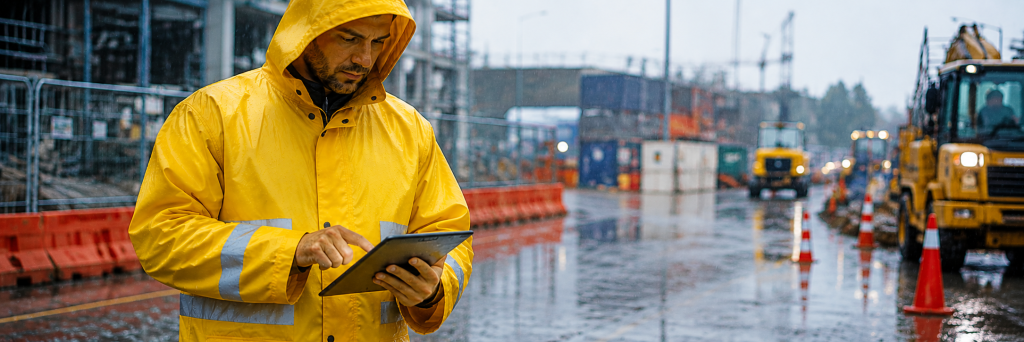
For suitable outdoor or exposed tasks, the Livingstone Rain Coat Jacket provides a reusable PVC option with long sleeves, a hood and pockets. The reusable PVC hooded raincoat is available in multiple sizes, including Large, and should be selected to suit the worker, task and other required PPE.
Safe Work Australia recommends monitoring weather conditions and reducing or postponing outdoor work when hazardous weather creates unacceptable risk. Waterproof clothing may form part of the remaining controls when work can proceed safely. Workplaces comparing sizes and wet-weather options can also review Livingstone’s Rain Coat Collections.
When Should a Rain Coat Jacket Be Used at Work?
A rain coat jacket can be worn when workers need protection from rain while carrying out suitable outdoor or exposed tasks. It should be used alongside weather monitoring, shelter, safe work procedures and other controls rather than as a reason to continue work when conditions have become hazardous.
Wet weather itself is only one consideration.
Safe Work Australia identifies heavy or sudden rain, strong winds, flooding and lightning among weather conditions that employers should monitor. Where conditions become unsafe, work may need to move indoors, be postponed or stop altogether.
- outdoor maintenance
- loading and unloading
- grounds work
- construction and site inspections
- warehousing yards
- transport and logistics
- agriculture
- facility maintenance
- temporary outdoor duties
The important question is not simply whether it is raining. It is whether the task can still be performed safely once reduced visibility, wet surfaces, wind and other conditions are taken into account.
What Does a Reusable PVC Hooded Raincoat Provide?
A reusable PVC hooded raincoat provides a physical outer layer intended to help keep the wearer protected from rain. A hood extends coverage to the head, while long sleeves protect the arms. Reusable construction also allows the garment to be retained for future wet-weather tasks when properly cleaned, dried and inspected.
Livingstone describes its rain jackets as reusable PVC garments with long sleeves, a hood and pockets. The range is yellow and is available in multiple sizes.
Those features have practical implications.
A hood reduces the need for a separate rain covering around the head, although it must not interfere with required head protection. Pockets can provide temporary storage for suitable small items, while the longer jacket body offers more coverage than a short upper-body shell.
PVC is also commonly selected for rainwear because it creates a barrier against water.
That does not mean every PVC raincoat is suitable for every hazard. Chemical exposure, high heat, electrical work and specialised industrial environments may require protective clothing with specific certifications or material properties.
Always select the garment for the actual hazard rather than relying on its waterproof construction alone.
How Should Wet Weather Clothing Fit With Other PPE?
Wet weather clothing should be selected so that it can be worn safely with any other PPE required for the task. A raincoat should not restrict movement, obscure vision, interfere with a hard hat or prevent high-visibility, respiratory, fall-protection or other safety equipment from functioning correctly.
Safe Work Australia states that PPE must be suitable for the worker and the task and should be used as part of a broader risk-management approach. PPE is not intended to replace higher-level controls.
WorkSafe Queensland also recommends checking whether different items of PPE can be worn together effectively.
- whether the worker can move freely
- whether sleeves interfere with gloves
- whether the hood works with required head protection
- whether high-visibility requirements remain satisfied
- whether the garment can be fastened securely
- whether footwear remains suitable for wet surfaces
- whether the worker can still perform the task safely
Fit is especially important when workers bend, climb, carry equipment or repeatedly enter and leave vehicles.
A garment that looks suitable while standing still may behave differently during the actual task.
What Should Workplaces Check Before Choosing Reusable Rainwear?
Workplaces should consider the type of work, expected weather exposure, required PPE, garment size, material and how often the rainwear will be used. Reusable rainwear should also have a practical cleaning, drying and storage process so it remains available in serviceable condition between periods of wet weather.
Start with the work rather than the garment.
Someone crossing a yard occasionally has different needs from a worker spending several hours outdoors. Likewise, a general-purpose raincoat should not automatically be selected for chemical handling or another specialised hazard.
- expected duration of rain exposure
- required body coverage
- garment sizing
- hood and pocket requirements
- compatibility with other PPE
- reusable versus disposable construction
- storage space
- cleaning arrangements
- replacement frequency
Livingstone’s rain jacket range includes Small, Medium, Large, Extra Large and Double Extra Large options.
Providing a suitable size range is preferable to expecting workers with different builds to use one oversized garment.
How Should a Reusable Rain Coat Jacket Be Maintained?
Reusable rainwear should be checked before use, cleaned when contaminated or dirty, allowed to dry thoroughly and stored where it will not be crushed or damaged. Garments showing tears, failed fasteners, damaged seams or deterioration that affects their intended function should be repaired where appropriate or replaced.
Maintenance is easy to overlook because rainwear may remain stored for long periods between wet-weather events.
WorkSafe Queensland notes that care and maintenance are essential if PPE is to continue providing the intended level of protection, and recommends checking for broken or damaged components before use.
- checking the PVC surface for splits or punctures
- inspecting seams and closures
- checking the hood and drawstrings
- removing dirt after use
- allowing the garment to dry before storage
- keeping it away from sharp items
- confirming the correct size remains assigned or available
If the raincoat becomes contaminated with chemicals or another hazardous substance, follow the relevant workplace procedure rather than treating it as ordinary wet clothing.
Can a Raincoat Make Hazardous Weather Safe to Work In?
No. A raincoat cannot make hazardous weather safe. Waterproof clothing may reduce exposure to rain, but it does not control hazards such as lightning, flooding, high winds, poor visibility or unstable work surfaces. Work should be delayed, relocated or stopped when those risks cannot be adequately controlled.
This is one of the most important distinctions when planning wet-weather work.
Safe Work Australia states that eliminating exposure to hazardous weather is the best protection. Examples include scheduling work indoors or delaying outdoor tasks until conditions improve. Waterproof clothing is listed as one possible protective measure after those broader controls have been considered.
A raincoat therefore deals with one part of the problem: getting wet.
- vehicles losing traction
- slippery ladders or platforms
- lightning exposure
- flash flooding
- strong wind
- falling objects
- reduced visibility
Before outdoor work continues, supervisors should reassess the entire task rather than simply issuing wet-weather clothing.
When Does It Make Sense to Buy Rain Coats Online for a Workplace?
Workplaces may choose to buy rain coats online when they need consistent sizes and quantities across maintenance teams, outdoor workers, site vehicles or emergency stores. Before ordering, review workforce numbers, sizing, expected use and storage requirements rather than purchasing a single size for everyone.
For organisations managing several outdoor teams, purchasing should begin with a basic inventory.
Check how many workers may need rainwear at the same time, whether contractors or visitors require access to spare garments and whether jackets are stored centrally or allocated individually.
It is also worth checking garments before the wet season rather than discovering shortages during a downpour.
Facilities comparing different rainwear formats can review Livingstone’s rain coat and wet-weather clothing range for alternative sizes and styles.
References
Safe Work Australia 2026, Working Outdoors, Safe Work Australia, viewed 27 August 2026.
Safe Work Australia 2026, Working in Hazardous Weather, Safe Work Australia, viewed 27 August 2026.
Safe Work Australia 2026, Personal Protective Equipment (PPE) – Workers, Safe Work Australia, viewed 27 August 2026.
Safe Work Australia 2024, Working Outside in Summer, Safe Work Australia, viewed 27 August 2026.
WorkSafe Queensland n.d., Personal Protective Equipment (PPE), WorkSafe Queensland, viewed 27 August 2026.