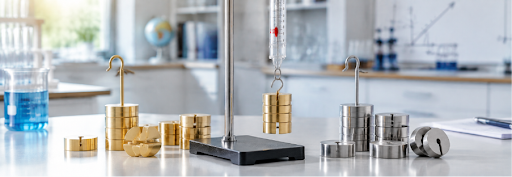
Spring balances support classroom physics experiments by allowing students to measure force directly and investigate concepts such as weight, friction, elasticity and buoyancy through practical activities. By showing how a calibrated spring responds when a load is applied, they help students connect physical movement with measurable force and mathematical relationships. Schools and laboratories can browse the school science lab physics range or compare current options in the Spring Balances listing.
What Is a Spring Balance?
A spring balance is a measuring instrument that uses the extension of a calibrated spring to measure force, most commonly the weight of an object. It usually consists of a ring or handle at the top, a hook at the bottom and a scale displayed along a tube or housing.
In physics, weight refers to the force caused by gravity acting on an object, and its SI unit is the newton (N). Some spring balances display values in grams for convenience, but the instrument fundamentally measures force. The displayed mass value is calculated from the relationship between mass and gravitational force rather than being measured directly.
Spring balances are widely used in science education because they provide a simple way for students to observe invisible forces through measurable movement.
How Does a Spring Balance Work?
A spring balance works using Hooke’s law, which states that within a spring’s elastic limit, its extension is proportional to the applied force. When a load is attached, the spring stretches and moves a pointer or scale indicator to show the measured force.
Within the operating range of the instrument, increasing the applied force produces a proportional increase in extension, allowing the scale to be calibrated with consistent markings. If the spring is stretched beyond its elastic limit, it may deform permanently and produce unreliable readings.
Because weight is a force, a known mass can be used to demonstrate the relationship between mass and gravitational force. For example, a 100 g mass has a weight of approximately 0.98 N under Earth’s gravity, although the exact value depends on local gravitational conditions.
How Is a Spring Balance Used in Classroom Experiments?
A spring balance is used to measure forces directly, making it suitable for several classroom investigations:
- Weight and mass: Students can hang known masses and compare measured forces with calculated values.
- Hooke’s law: Students can add loads in steps, record spring extension and investigate whether the relationship remains proportional.
- Friction: Students can pull an object across different surfaces at a steady speed and measure the required force.
- Buoyancy: Students can compare the weight of an object in air and when submerged in water to investigate the upward force created by fluids.
- Inclined planes: Students can measure the force required to move an object up a slope and compare it with other forces acting on the system.
These activities support science learning by helping students investigate forces, collect measurements and analyse relationships between variables. Australian science curriculum outcomes include investigating forces and how they affect motion, making spring balances useful tools for practical demonstrations.
What Is the Difference Between a Spring Balance and an Electronic Balance?
A spring balance measures force through the extension of a calibrated spring, whereas an electronic balance uses sensors to measure and display mass digitally.
| Feature | Spring balance | Electronic balance |
| Measures | Force (weight) | Mass displayed digitally |
| Power | No power required | Requires batteries or mains power |
| Best for | Teaching forces, portable demonstrations and practical investigations | Measuring small mass differences and precise preparation tasks |
A spring balance is useful when the learning objective involves forces and motion, while an electronic balance is more suitable when accurate mass measurement is the priority.
How Do You Choose the Right Spring Balance?
Choosing the right spring balance starts with selecting a suitable measurement range. The maximum capacity should exceed the heaviest expected load, while typical measurements should fall within the middle to upper portion of the scale for easier reading.
The smallest scale division should also match the level of precision required for the experiment. For classroom demonstrations, a balance with clear markings may be more valuable than one designed for very fine measurements.
Materials and construction can influence durability. Plastic-bodied spring balances are lightweight and commonly used in student activities, while models with stronger housings may be preferred for frequent handling. However, the manufacturer’s specifications, measurement range and accuracy information should always guide selection rather than assuming one material is automatically better.
An adjustable zero point and clearly visible scale markings can also help students collect more reliable results.
How Do You Get an Accurate Reading From a Spring Balance?
Accurate readings depend on consistent measurement technique. Follow these steps:
- Zero first: Ensure the pointer returns to zero before attaching a load. Adjust the zero setting if the model allows.
- Hang vertically: Keep the spring balance straight to avoid additional forces caused by angled positioning.
- Wait for stillness: Allow the pointer to settle before recording the reading.
- Read at eye level: This reduces errors caused by viewing the scale from the wrong angle.
- Repeat measurements: Take several readings and calculate an average where appropriate.
- Stay within capacity: Avoid overloading the spring, as excessive force may permanently affect accuracy.
These practices help reduce measurement errors and improve the reliability of classroom experiment results.
What Laboratory Considerations Apply?
Spring balances should be treated as teaching instruments and maintained accordingly. Regular checks using known masses can help identify whether readings have changed over time or whether the spring is no longer returning accurately to zero.
Measurement standards provide a consistent foundation for scientific work, and Australia’s national measurement system supports reliable measurement practices across different fields.
For analogue spring balances, reading uncertainty is often estimated as around half of the smallest scale division, depending on the instrument design and measurement method. Students should record uncertainty when comparing experimental results.
For higher precision applications, calibrated electronic or analytical instruments are generally more suitable. Spring balances should also be stored unloaded and protected from heat, moisture and corrosive environments.
Safety considerations remain simple but important. Keep suspended loads over a clear workspace, avoid standing directly below hanging objects and use appropriate protective equipment when there is a risk of a load swinging or becoming detached.
Why Does the Spring Balance Still Matter in Science Education?
The spring balance helps students visualise forces by turning an invisible interaction into a measurable stretch, pointer movement and numerical result. It introduces important scientific skills including measurement, observation, recording data and evaluating uncertainty.
Although digital sensors are common in modern laboratories, spring balances remain valuable because they are simple, portable and effective for demonstrating fundamental physics concepts. They allow students to connect mathematical relationships with physical experiences before moving into more advanced measurement systems.
References
Department of Industry, Science and Resources (DISR), n.d. Australia’s Measurement System.