A dental model can look straightforward once it is sitting on the bench, but the result depends on a series of small laboratory decisions made before the stone has even set. Powder measurement, water ratio, mixing technique, vibration and storage all influence whether a cast is clean, stable and practical to work with.
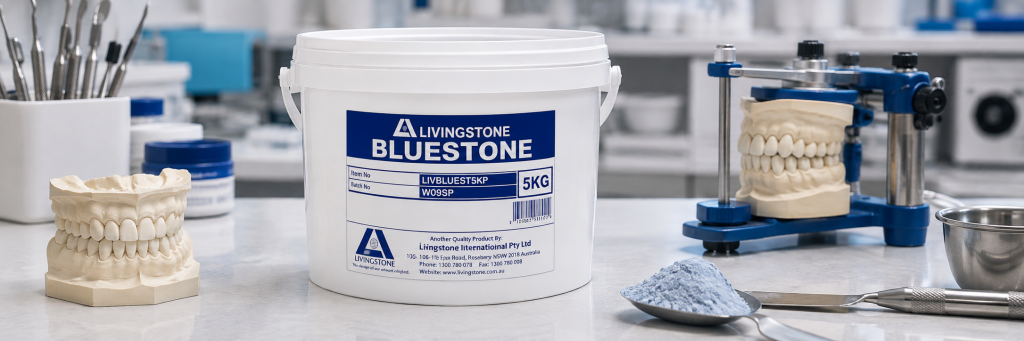
Dental bluestone is commonly selected for routine model work where a harder laboratory material is needed than ordinary plaster. It gives technicians a practical material for pouring impressions and producing working or study models, while still being manageable during trimming and finishing when the correct technique is followed.
For practices and laboratories that use dental stone regularly, the Livingstone Bluestone provides a convenient format for routine model production. The product fits within a broader workflow that includes accurate measuring, controlled mixing, careful pouring and appropriate handling of finished casts rather than relying on the stone alone to determine the final result. Laboratories comparing related model materials can also review the Livingstone Dental Stone Collection.
What Is Dental Bluestone and When Is It Used?
Dental bluestone is a dental laboratory stone used for producing hard casts and models from dental impressions. It is suited to general-purpose model making where technicians need a model that can retain anatomical detail, withstand routine handling and remain practical to pour, trim and finish in the laboratory.
In routine laboratory work, stone models may be used to represent teeth, soft-tissue contours and arch relationships after an impression has been taken. Depending on the case, the model can assist with study, appliance fabrication, mounting or other laboratory stages requiring a physical reproduction of oral anatomy.
The key is matching the material to the task. A general-purpose dental laboratory stone may be appropriate for many models, while more specialised work can call for a different stone class or formulation. Technicians should follow the product instructions and the requirements of the case rather than treating every gypsum material as interchangeable.
How Does Dental Laboratory Stone Differ From Ordinary Dental Plaster?
Dental laboratory stone is generally harder and more resistant to routine handling than standard model plaster. This makes it better suited to casts that need clearer detail, stronger edges or repeated laboratory handling, while plaster can remain useful for applications where lower strength and easier trimming are acceptable.
Gypsum products are manufactured in different forms because laboratory tasks place different demands on the finished model. A stone intended for model making is formulated to produce a denser, harder cast than conventional plaster when it is mixed and handled correctly. That difference is useful around tooth surfaces, margins and areas handled repeatedly during laboratory procedures.
Harder does not automatically mean better for every job. The appropriate choice depends on the impression, the intended use of the cast and the amount of trimming or manipulation expected after setting. For routine model production, selecting a stone designed for general-purpose dental models can provide a useful balance between durability and workable handling.
How Should Dental Stone Be Mixed for Consistent Models?
Dental stone should be measured and mixed according to the manufacturer’s stated powder-to-water ratio and working instructions. Consistent measuring, controlled spatulation and careful pouring help reduce variation between batches and give the material the best chance of producing a dense, detailed and dependable laboratory model.
Adding water by eye or repeatedly altering the mix during spatulation can change the consistency from one cast to the next. Using the same measuring equipment and sequence for each batch helps produce more predictable flow, working time and set characteristics.
Once mixed, introduce the stone into the impression gradually rather than filling the entire impression at once. Gentle vibration can help the material move into detailed areas and allow trapped air to escape. Excessive vibration or an overly fluid mix can create other problems, so the technique should remain controlled and consistent.
What Causes Bubbles, Weak Edges or Inaccurate Dental Stone Models?
Bubbles, weak edges and inaccurate stone models are often linked to mixing or pouring errors, unsuitable water ratios, contamination, poor impression handling or disturbing the cast before it has set adequately. Reviewing the full workflow is more useful than assuming the dental stone itself is responsible for every defect.
Air can become trapped when the mix is folded aggressively, when stone is placed too quickly into fine impression detail or when vibration is poorly controlled. Too much water can also contribute to weak or chalky areas. Following the stated mixing ratio and introducing stone progressively helps reduce avoidable variation.
The impression also matters. Debris, excess moisture, damaged detail or delays that affect the impression material can be transferred directly to the cast. Before pouring, technicians should check that the impression is suitable for the selected stone and that any cleaning or disinfection steps have been completed according to the relevant material and infection-control procedures.
How Should Dental Stone Powder Be Handled and Stored in the Laboratory?
Dental stone powder should be kept dry, stored in a closed container and handled in a way that limits unnecessary dust. Laboratory staff should follow the product instructions and safety data sheet, keep the work area clean and apply workplace controls appropriate to the risks identified for handling powdered materials.
Moisture can affect stored gypsum products, so closing the container promptly after use is a simple but important part of stock care. Scoops and measuring tools should also be clean and dry before they are returned to the product. An organised mixing area also helps prevent cross-contamination and unwanted debris entering a batch.
Powder handling should also be considered from a workplace-safety perspective. Safe Work Australia advises workplaces to use safety data sheets when managing hazardous chemicals and related risks. Where dust may be generated, the laboratory should assess exposure and use suitable controls based on the product information, the task and local work health and safety requirements.
What Should You Consider When Choosing Dental Stone for Routine Laboratory Work?
Choose dental stone by considering the type of model being produced, the required hardness, detail reproduction, working characteristics, package size and compatibility with the laboratory’s established procedures. The best option is the one that fits the case requirements and can be used consistently by the team.
For a laboratory producing general study or working models, ease of pouring and trimming can be just as important as the hardness of the cast. Technicians should also consider usage frequency, storage time after opening and whether the container can be kept clean and dry.
The Livingstone dental stone collection allows practices to compare model materials within the same category rather than choosing on colour or price alone. Reviewing the intended application and manufacturer guidance helps narrow the choice to a stone that fits the laboratory process instead of forcing the process around an unsuitable material.
When Does It Make Sense to Buy Dental Stone Online in Bulk?
Bulk purchasing dental stone makes sense when a practice or laboratory has steady model-making demand, suitable dry storage and a reliable way to rotate stock. Buying larger or multiple packs can reduce ordering frequency, but quantity should reflect real usage and suitable storage conditions.
Before placing a larger order, review average consumption over several weeks or months rather than estimating from a busy period. Storage space, container size and actual consumption all affect whether bulk supply is practical. A smaller pail may be more manageable where stone is used only occasionally.
When teams buy dental stone online, it is also useful to compare the product format with the broader laboratory workflow. Reliable supply matters, but so do consistent measuring, safe handling and correct storage after delivery. Purchasing decisions work best when they are tied to actual laboratory demand rather than simply choosing the largest available pack.
How Can Dental Laboratories Get More Consistent Results From Dental Bluestone?
Consistent results come from matching the stone to the model, measuring powder and water accurately, mixing and pouring with a repeatable technique, allowing the cast to set properly and storing unused material in dry conditions. Material choice matters, but disciplined laboratory handling matters just as much.
Reliable dental models come from a repeatable process. The stone needs to suit the intended cast, but accurate measuring, careful mixing, controlled pouring, appropriate setting time and dry storage all contribute to the quality of the finished result.
Livingstone Bluestone 5kg Pail can be considered for routine dental laboratory model making where a general-purpose dental stone fits the case and the laboratory’s established procedures. Practices can also review the wider dental stone collection when different model requirements call for another material or pack format.
The practical takeaway is simple: choose the stone for the job, follow the manufacturer’s instructions and keep the laboratory technique consistent from one batch to the next. Recording the same measuring and mixing routine can also help teams maintain repeatability when several people share model-making duties.
References
Ainsworth Dental Company n.d., Ainsworth Bluestone 5Kg Pail, viewed 26 August 2026.
Australian Dental Association n.d., Infection Prevention and Control, viewed 26 August 2026.
Australian Commission on Safety and Quality in Health Care 2019, updated 2026, Australian Guidelines for the Prevention and Control of Infection in Healthcare, viewed 26 August 2026.
Safe Work Australia n.d., Safety data sheets, viewed 26 August 2026.