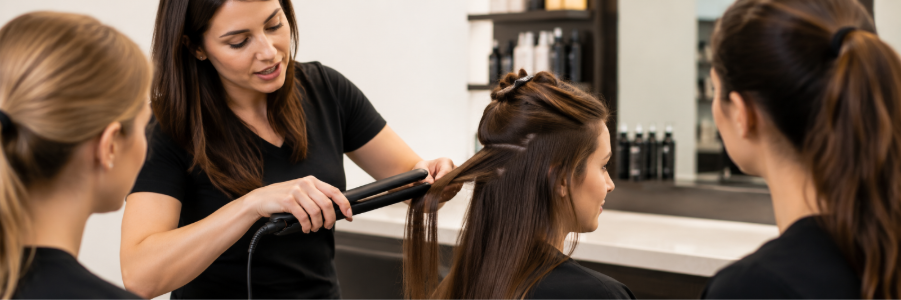
Precision in haircutting depends on technique, but it also relies on how well the hair is controlled and how consistently the developing shape is checked. Sectioning clips keep working areas organised, while a hand mirror gives the stylist and client another view beyond the main station mirror. Used together, they support a more controlled workflow from the first section to the final check.
Australian hairdressing training reflects this practical approach. National Training Register haircutting units list sectioning clips among standard workstation tools and require hair to be sectioned and secured into manageable areas. TAFE NSW hairdressing training also covers haircut structures, cutting techniques and organised tools and work areas.
Why Do Sectioning Clips Matter in a Professional Haircut?
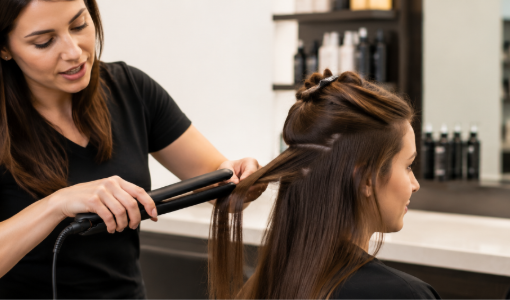
Sectioning clips help divide and secure hair so the stylist can work through a haircut in controlled areas. Clean sectioning makes it easier to follow a planned structure, maintain visibility and prevent loose hair from falling back into the working section. The same principle can help home users make trimming or assisted cutting more organised.
The National Training Register refers to sectioning and securing hair into manageable and controllable areas during haircutting and lists sectioning clips as required workstation equipment in several haircut units. In salon work, this can support concentration by keeping completed areas separate from the section being cut.
The Sofeel Nylon/Aluminium Sectioning Clips are supplied as a black 12-piece pack and are intended for sectioning hair during cutting and styling. They support the controlled setup needed for consistent technique.
How Does a Hand Mirror Support Precision During and After a Haircut?
A rectangular hand mirror provides a second viewing angle, helping the stylist and client see areas that may be difficult to assess directly in the main station mirror. It is particularly useful for reviewing the back, neckline, side balance and overall silhouette before the service is completed.
Mirrors are standard equipment in professional hairdressing workstations. A portable mirror extends that view because it can be repositioned around the client as needed. For the stylist, it can be used as a checkpoint rather than only for the final reveal. For the client, it creates an opportunity to review the back and sides before leaving the chair.
What Mirror Size and Design Is Best for Salon Use?
There is no single hand-mirror size that is best for every salon. A practical mirror should provide enough reflective area to show the section being reviewed while remaining comfortable to hold, angle and move around the client. Handle design, durability, weight and ease of cleaning are also relevant.
A rectangular shape can provide a broad viewing area for checking the back and sides. A handle can make positioning easier when the stylist holds the mirror behind the client while they look into the main station mirror.
How Do These Two Tools Work Together in a Haircut Workflow?
Sectioning clips organise the hair while the cut is being created, and a hand mirror helps review how the overall result is developing. Their roles are different, but together they support a workflow that combines physical control of the hair with regular visual checking.
A practical approach is to section the hair according to the planned structure, secure areas that are not currently being cut and work through each section systematically. At suitable checkpoints, the stylist can use the mirror to review balance, shape and how the cut appears from the client’s perspective.
This can help identify adjustments before finishing work begins and support clearer communication.
Frequently Asked Questions
What is the advantage of a rectangular mirror over a round one for salon use?
A rectangular mirror can provide a wider viewing area across the back of the head, which may be useful when checking the neckline, rear shape and side-to-side balance. A round mirror can still work effectively, so shape alone does not determine performance.
For salon use, the more important factors are clear visibility, comfortable handling and easy positioning. The mirror should give both stylist and client a useful second perspective without making the service awkward.
Precision haircutting is built on repeatable habits: controlled sectioning, careful cutting and regular visual checks. Sectioning clips and a hand mirror support those habits in different ways. For salons, they can help make services more organised and client-focused. For home users, they can make cutting and checking results easier to manage across both professional and personal haircutting routines.
References
Australian Hairdressing Council (2023) Industry standards and professional practice guidelines. https://www.theahc.org.au/industry-resources
TAFE NSW (2024) Certificate III in Hairdressing: course overview and industry pathways. https://www.tafensw.edu.au/courses-and-qualifications/beauty-and-hair
Australian Government, National Training Register. SHBHCUT005 Cut Hair Using Over-Comb Techniques.
https://training.gov.au/Training/Details/SHBHCUT005
Australian Government, National Training Register. SHBHCUT006 Create Combined Haircut
https://training.gov.au/training/details/SHBHCUT006/unitdetails
TAFE NSW. Certificate III in Hairdressing.
https://www.tafensw.edu.au/course-areas/hair-and-beauty/courses/healthcare–SHB30416-01