
Laboratory workflow depends not only on accurate instruments and skilled staff, but also on how efficiently samples, equipment and consumables move between benches, storage areas and testing stations. Mobile storage can help reduce unnecessary movement and keep frequently used items organised. Depending on the task, laboratories may choose a stainless steel trolley with no drawer for open-access storage or a stainless steel trolley with drawer when smaller consumables need enclosed storage. Selecting a suitable configuration can support cleaner work areas, more consistent routines and safer equipment movement across laboratory and healthcare settings.
What Makes Stainless Steel Suitable for Laboratory Trolleys?
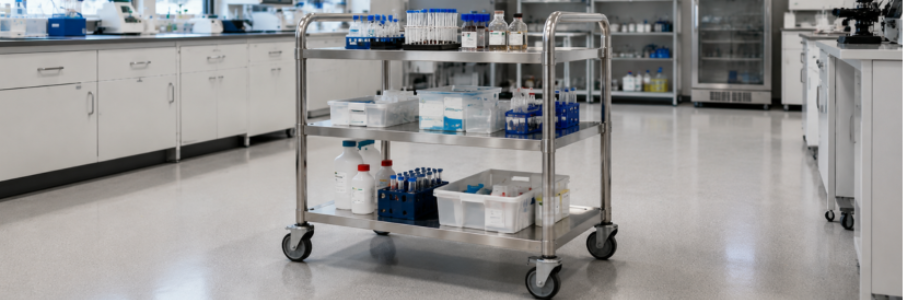
Stainless steel suits laboratory trolleys because it combines a durable, non-porous surface with good corrosion resistance and straightforward cleaning. Where equipment is moved frequently and included in routine cleaning procedures, these qualities can support practical day-to-day maintenance, consistent presentation and a longer useful service life.
Laboratories handle samples, reagents, consumables, and cleaning products, so trolley surfaces need to remain serviceable under regular use. Stainless steel can tolerate frequent wiping and offers good resistance to corrosion under many routine laboratory conditions. Facilities should still follow manufacturer care instructions and their own cleaning procedures rather than assuming universal chemical compatibility.
How Can Stainless Steel Trolleys Support Laboratory Hygiene?
Smooth, non-porous stainless-steel surfaces are relatively easy to clean and disinfect, supporting routine hygiene and infection prevention procedures. This is especially relevant where trolleys transport samples, consumables or equipment between work areas and therefore need to be included in the facility’s regular environmental cleaning schedule.
The Australian Commission on Safety and Quality in Health Care emphasises maintaining a clean and safe healthcare environment as part of infection prevention practice. For laboratories linked with clinical services, using equipment that can be cleaned effectively can support these wider environmental hygiene procedures (Australian Commission on Safety and Quality in Health Care 2024).
How Do Trolleys Improve Laboratory Workflow Efficiency?
A laboratory trolley can improve workflow by allowing staff to move samples, equipment and consumables together rather than making repeated trips to storage. Keeping frequently used items near the work area can also reduce bench clutter, support more consistent preparation, and leave fixed work surfaces available for active laboratory procedures.
In busy laboratories, repeated trips to cupboards, stores, or shared equipment areas can interrupt a task. A trolley can act as a mobile staging point for the items required for a particular procedure, helping staff prepare materials before starting and keeping related supplies together while the work is underway.
How Can Laboratory Trolleys Support Safer Manual Handling?
Using a suitable trolley can reduce repeated lifting and carrying when equipment or supplies need to be moved between work areas. This can help organisations manage manual handling risks, provided the trolley is appropriate for the load, travel path and the way staff are expected to push, pull or position it.
WorkSafe Victoria advises selecting trolleys to suit the load, travel path and people involved, while Safe Work Australia identifies mechanical aids as one way of managing hazardous manual tasks (WorkSafe Victoria 2023; Safe Work Australia n.d.). Trolleys should therefore form part of a broader risk-management approach.
How Do Trolleys Support Laboratory Organisation and Consistency?
Laboratory trolleys can support organisation by giving frequently used materials a defined storage location and movement pathway. Standardising how a trolley is stocked for a particular activity can reduce searching, limit unnecessary bench clutter and make routine processes easier to follow across different staff members, shifts or teaching groups.
Facilities may assign trolleys to specimen collection, equipment preparation, teaching activities or general consumable transport, depending on workflow. When the setup remains consistent, staff can identify where required items belong and return supplies after use without relying on several temporary storage locations around the laboratory.
What Should Labs Consider When Choosing a Stainless-Steel Trolley?
Laboratories should assess a trolley against the work it will perform, including expected load, shelf or drawer configuration, wheel type, manoeuvrability and cleaning requirements. The most suitable option is one that fits the laboratory workflow, carries the intended equipment appropriately, and can be maintained within the facility’s normal cleaning procedures.
Load capacity should reflect the heaviest realistic combination of equipment and supplies. Shelf spacing and drawer configuration determine how items can be organised, while wheel quality affects how easily staff can move the trolley through corridors and around laboratory furniture. Facilities should also confirm that the finish and joins can be cleaned effectively in line with site procedures.
For procurement teams, the decision should therefore focus on intended use rather than selecting a trolley by capacity alone. Matching storage configuration and mobility to the actual task can help laboratories avoid oversized equipment, insufficient storage, or a trolley that is difficult to use in the available workspace.
How Often Should Laboratory Trolleys Be Cleaned?
Cleaning frequency should follow the facility’s procedures, the trolley’s level of use and the type of work area it services. High-use trolleys or those moving between work zones may require more frequent attention, while spills or visible contamination should be managed promptly according to established cleaning and infection control requirements.
A documented routine can make responsibilities clearer and help prevent mobile equipment from being overlooked during environmental cleaning. Laboratories should use cleaning products and methods that are appropriate for the trolley surface and consistent with manufacturer instructions and site procedures.
Why Are Stainless Steel Trolleys a Practical Choice for Laboratories?
Stainless steel trolleys offer laboratories a practical combination of mobile storage, cleanable surfaces and organised equipment movement. When the trolley is matched to the task and work area, it can support more consistent workflows, reduce unnecessary carrying, and keep frequently used supplies accessible without permanently occupying valuable bench space.
For laboratories and healthcare facilities reviewing equipment transport, the priority should be choosing a configuration that suits the load, available space, cleaning procedures, and daily workflow. A well-selected trolley can become a simple but useful part of maintaining organised, efficient and safer day-to-day operations.
References
Australian Commission on Safety and Quality in Health Care (2024) Clean and safe environment, ACSQHC, Sydney, viewed 25 August 2026, https://www.safetyandquality.gov.au/resources/fact-sheet-action-313-clean-and-safe-environment
Safe Work Australia (n.d.) Model Code of Practice: Hazardous manual tasks, Safe Work Australia, Canberra, viewed 25 August 2026, https://www.safeworkaustralia.gov.au/system/files/documents/1905/model-cop-hazardous-manual-tasks.pdf
WorkSafe Victoria (2023) Choosing and using trolleys, WorkSafe Victoria, Melbourne, viewed 25 August 2026, https://www.worksafe.vic.gov.au/choosing-and-using-trolleys.