Food safety is never left to chance in a well-run kitchen or care facility. Every surface, utensil, and pair of hands play a part in preventing contamination, and the difference between a safe service and a serious incident often comes down to consistent cleaning and hygiene routines. Choosing reliable tools, such as sanitiser wipes for quick surface disinfection and vinyl gloves rated for food handling, gives staff the practical means to maintain these standards throughout a busy shift. For healthcare, aged care, and hospitality operators alike, understanding how cleaning and hygiene work together is the foundation of a safe environment for staff, patients, and customers.
Why Is Cleaning and Sanitising Essential for Food Safety?
Cleaning and sanitising remove dirt, grease, and harmful microorganisms from surfaces before they can spread to food or people. Together they break the chain of contamination, protecting vulnerable groups such as patients, aged care residents, and diners from foodborne illness and cross-contamination risks in shared environments.
Without both steps performed correctly, food contact surfaces can harbour bacteria even when they appear visibly clean. This is particularly important in healthcare and aged care settings, where residents and patients may have weakened immune systems and are more susceptible to infection. Hospitality venues face similar pressures, as a single lapse in hygiene can affect dozens of customers in a short space of time. Establishing a routine that treats cleaning and sanitising as separate, sequential steps helps staff avoid shortcuts that compromise safety.
Consistency matters as much as technique. A cleaning routine that works well on a quiet morning shift can fall apart under the pressure of a full dining room or a busy ward, which is why hygiene expectations need to be built into daily workflow rather than treated as an occasional task. Regular supervision and simple visual reminders around wash stations can reinforce good habits without adding unnecessary complexity to a team’s day.
What Is the Difference Between Cleaning and Sanitising?
Cleaning physically removes visible dirt, food residue, and grease using detergent and water, while sanitising uses heat or chemical agents to reduce microorganisms on an already clean surface. Skipping the cleaning step reduces the effectiveness of sanitising, since residue can shield bacteria from contact with the sanitising agent.
Many staff assume that a quick wipe achieves both outcomes, but this is a common misconception. A surface must be physically clean before sanitising can work as intended. Detergent breaks down grease and lifts debris away, while a properly diluted sanitiser then targets the remaining microorganisms. Facilities that document this two-step process in their cleaning schedules tend to see fewer compliance issues during inspections and audits.
How Often Should Food Contact Surfaces Be Sanitised?
Food contact surfaces should be sanitised before use, after handling raw ingredients, between different tasks, and at the end of each shift. High-touch areas such as benchtops, cutting boards, and handles need more frequent attention, particularly when different food types are being prepared in the same space.
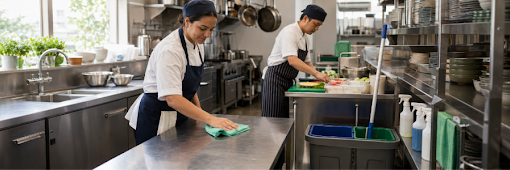
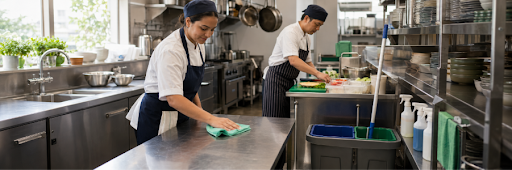
Facilities operating across long shifts should build sanitising checkpoints into their workflow rather than relying on memory. Colour-coded cloths and designated wipe stations help staff maintain consistency, especially during peak periods when time pressure increases the temptation to cut corners. Single-use sanitiser wipes are a practical option for smaller kitchens or care settings, reducing the cross-contamination risk that comes from reusing a shared cloth across multiple surfaces.
What Role Do Gloves and PPE Play in Food Hygiene?
Gloves and other personal protective equipment create a physical barrier between hands and food, reducing the risk of transferring bacteria, allergens, or contaminants. Well-fitted, food-grade gloves support safe handling practices when combined with proper hand hygiene rather than replacing it entirely.
Gloves are not a substitute for handwashing. Bacteria can multiply on gloved hands just as easily as on bare skin if gloves are worn for extended periods or reused between tasks. Staff should be trained to change gloves regularly, particularly after touching raw food, waste, or non-food surfaces, and to wash their hands both before gloving up and after removal.
How Can Businesses Build an Effective Cleaning Schedule?
An effective cleaning schedule assigns clear responsibility for each task, specifies the correct method and frequency, and includes a simple way to record completion. Written schedules reduce reliance on memory and give managers a practical tool for demonstrating compliance during audits or inspections.
Schedules should reflect the specific risks of each area, with high-risk zones such as food preparation benches and equipment used for raw protein receiving more frequent attention than lower-risk storage areas. Reviewing the schedule periodically, and updating it as menus, equipment, or layouts change, keeping hygiene practices aligned with actual operations rather than outdated assumptions.
What Are the Consequences of Poor Hygiene Practices?
Inadequate cleaning and hygiene practices increase the risk of foodborne illness outbreaks, regulatory penalties, and reputational damage. For healthcare and aged care providers, the consequences extend further, potentially affecting vulnerable residents whose health outcomes depend heavily on a controlled, hygienic environment.
Beyond the immediate health risks, poor hygiene can lead to closed premises, lost trust, and costly remediation work. Building strong habits around cleaning, sanitising and PPE use protects not only compliance outcomes but also the well-being of everyone who relies on a safe food environment, from hospital patients to hospitality guests.
References