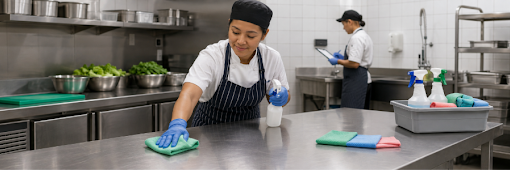
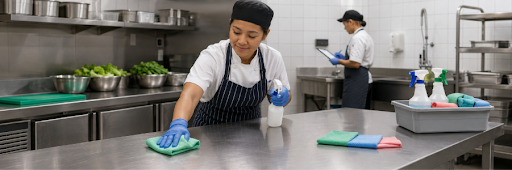
For hospitality groups operating across several venues, from serviced apartments and function centres to aged care dining rooms and quick service outlets, the choice of everyday consumables is rarely treated as a strategic decision. Yet the cleaning chemicals used in a back-of-house kitchen, the disposable aprons issued to food handlers, and the storage containers on a cool room shelf all influence food safety outcomes and brand consistency. When each site sources its own supplies, quality and compliance start to drift between locations. Standardising a core range of consumables, including facilities cleaning products and chemicals and HACCP ready disposable aprons, gives multi-site operators a single baseline that supports consistent service and compliance at every venue.
Why Should Multi-Site Hospitality Businesses Standardise Consumables?
Standardising consumables across multiple sites reduces variation in hygiene practice, simplifies staff training, and creates a consistent customer experience. It also strengthens supplier accountability and makes it easier to demonstrate compliance with food safety and workplace obligations across every location.
When a group relies on different suppliers at each venue, staff moving between sites often encounter unfamiliar equipment, which slows onboarding and increases the chance of misuse. A standardised range removes this friction, since staff trained at one site can move to another with the same confidence. For customers, standardisation is felt rather than seen, since a guest at one venue should receive the same standard of hygiene and presentation as another.
What operational risks arise when hospitality consumables are not standardised?
Inconsistent consumables across sites create gaps in hygiene practice, unpredictable stsock availability, and confusion when staff transfer between venues. These gaps increase the likelihood of noncompliance during audits and make it harder for management to track which products are actually in use at any given time.
Without a standardised approach, a manager may only discover during an audit that one venue has substituted a lower specification of apron or an incompatible cleaning chemical. This is hard to detect proactively, since purchasing is often done locally without central oversight, exposing the business to inconsistent handling standards.
How Does Standardisation Support Food Safety and Compliance?
Standardisation supports food safety by ensuring every site uses products that meet the same specifications, such as HACCP-appropriate aprons and correctly rated cleaning chemicals. This consistency makes food safety programs easier to audit and reduces the risk of preventable contamination.
Food safety standards in Australia require food businesses to manage risks at every point where food is handled, stored, or served, and this obligation applies equally to a single cafe and a national group (Food Standards Australia New Zealand, 2024). A standardised range gives operators a documented, repeatable answer to how those risks are controlled.
What Role Do HACCP-Aligned Consumables Play Across Sites?
HACCP-aligned consumables give every site a proven specification to work from, rather than leaving hygiene equipment choices to individual venue managers. This reduces variability at critical control points and supports the documented evidence that many food safety programs require during inspection or review.
Disposable aprons, gloves, and similar single-use items are often used at critical control points, including food preparation and plating. When these items are standardised to a HACCP-appropriate specification, a business can show auditors that the same verified product is used at every site, which matters most for businesses supplying food to hospitals or aged care facilities (Food Standards Australia New Zealand, 2024).
How Does Standardisation Improve Procurement and Cost Control in Hospitality Businesses?
Standardising consumables allows multi-site operators to negotiate with fewer suppliers, simplify ordering, and reduce the administrative burden of managing separate product lists at each venue. It also gives finance and operations teams clearer visibility over spending and stock levels across the entire network.
Procurement teams managing many product codes across several suppliers spend considerable time reconciling invoices and comparing specifications that should be identical. A standardised range condenses this into a smaller, better-understood set of products, simplifying budgeting as a network grows. Fewer supplier relationships also mean fewer points of failure, since one supplier able to reliably service every venue reduces the shortages and inconsistencies that arise from several regional suppliers each sourcing similar but not identical products.
How Do You Choose a Consumables Supplier for Multiple Hospitality Sites?
Choose a supplier that offers a consistent range across cleaning chemicals, personal protective equipment, and food storage, along with reliable stock across states. Confirm that products meet relevant Australian food safety and workplace standards before committing to one supplier across every site.
Workplace health and safety obligations require that protective equipment provided to staff is suitable and consistently available, which is difficult to guarantee when sourcing varies by location (Safe Work Australia, 2024). Operators should consider whether a supplier can service every site from the same catalogue, whether lead times are consistent across states, and whether the range covers what a hospitality business needs, from cleaning products through to food-grade storage.
Standardising hospitality consumables is not simply a purchasing exercise. It is a practical way to protect food safety standards, simplify training, and reduce the hidden costs of inconsistent supply while helping operators keep pace with sector requirements as they scale (business.gov.au, 2024). For operators managing multiple sites, one trusted range of cleaning products, protective equipment, and storage solutions provides the consistency that regulators and customers expect.
References
Business.gov.au (2024) Accommodation and food services industry.
Food Standards Australia New Zealand (2024) Food Safety Standards.
Safe Work Australia (2024) Personal protective equipment (PPE) – Overview.