Surgical scissors vary in blade tip, curvature, length and intended use, so selecting an appropriate instrument depends on the procedure and the level of control required. These design differences can affect how an instrument is handled and used during clinical procedures. Livingstone offers curved sharp/blunt surgical scissors alongside a broader range of medical scissors for different procedural requirements.
What Are the Main Types of Surgical Scissors?
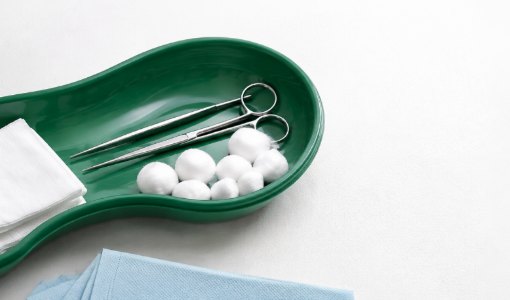
Surgical scissors are designed for different cutting and dissection tasks rather than general-purpose use. Common types include dissecting scissors for tissue, suture scissors for removing stitches, bandage scissors for dressings, and Mayo or Metzenbaum scissors for different levels of tissue dissection.
The design of each instrument reflects its intended application. Metzenbaum scissors typically have finer blades suited to more delicate dissection, while heavier scissors may be used where greater cutting strength is required. Suture and bandage scissors often incorporate blunt tips to help reduce accidental contact with the skin during use.
What Is the Difference Between Sharp and Blunt Surgical Scissors?
Sharp and blunt surgical scissors differ mainly in their tip configuration and are selected according to the intended use and procedural requirements. Sharp/blunt surgical scissors combine both tip styles in one instrument, providing one sharp and one blunt tip within the same pair of scissors. The appropriate configuration depends on the task being performed and the requirements of the procedure.
Sharp/blunt surgical scissors combine both tip styles in one instrument, providing a sharp and a blunt tip within the same pair of scissors. This configuration offers a general-purpose option for procedures where the characteristics of both tip styles may be useful.
When Are Straight or Curved Surgical Scissors Used?
Straight and curved surgical scissors are available for different procedural requirements, but their use depends on the instrument type, the area being treated and the technique used. Curvature alone should not be treated as an automatic indication of greater visibility, access, or control.
When selecting between straight and curved scissors, consider the instrument’s overall design rather than curvature in isolation. Tip configuration, length, and intended use should be assessed together to determine whether the scissors are appropriate for the procedure.
How Does Surgical Scissor Length Affect Clinical Use?
Surgical scissor length influences reach, handling, and control. Shorter instruments can support fine or superficial work where precise hand movements are important, while longer scissors provide additional reach when working in deeper or larger procedural areas.
The most suitable length depends on both the procedure and the user’s required access. Longer instruments can reach further into the working area, while more compact scissors may offer greater control for detailed cutting. Selecting an appropriate length helps avoid relying on one instrument for tasks that require different levels of reach.
What Should You Know About Stainless Steel Surgical Scissors?
Stainless steel is widely used for reusable surgical instruments because it can provide suitable strength and resistance to corrosion. However, the durability and cutting performance of surgical scissors depend on the specific instrument, its construction, condition, use, and the manufacturer’s instructions rather than the material alone.
Repeated use and reprocessing can affect instrument condition over time, so stainless steel surgical scissors should be inspected and maintained as part of the facility’s reprocessing procedures. Their ongoing suitability for use should be based on instrument condition and performance rather than assuming that stainless steel will retain the same cutting characteristics indefinitely.
What Should You Consider When Selecting Reusable Surgical Scissors?
Reusable surgical scissors should be selected according to the procedure, frequency of use, and the facility’s reprocessing requirements. Blade configuration, curvature, instrument length and intended cutting task should all be considered before adding scissors to an instrument tray.
Clinical settings that regularly use reusable instruments also need appropriate systems for cleaning, inspection, sterilisation and storage. Selecting scissors that match both the procedural task and the facility’s instrument-processing workflow can support more consistent handling across repeated use.
What Reprocessing Requirements Apply to Reusable Surgical Scissors in Australia?
Reusable surgical scissors used in Australian healthcare settings should be reprocessed in accordance with applicable requirements for reusable medical devices. The Australian Commission on Safety and Quality in Health Care’s Advisory PCHS24/01 states that AS 5369:2023 superseded AS/NZS 4187:2014 and AS/NZS 4815:2006 in December 2023. AS 5369:2023 specifies requirements for the reprocessing, storage, handling and transportation of reusable medical devices.
Reprocessing requirements extend beyond sterilisation. Advisory PCHS24/01 states that healthcare services using reusable equipment, instruments and devices need processes consistent with relevant national and international standards together with manufacturers’ guidelines. It also addresses traceability requirements for critical equipment, instruments and devices.
How Should Reusable Surgical Scissors Be Maintained?
Reusable surgical scissors should be cleaned and reprocessed according to the manufacturer’s instructions and applicable facility procedures. The Australian Guidelines for the Prevention and Control of Infection in Healthcare state that reusable medical devices should be visually inspected following cleaning and that equipment and instrument surfaces should be regularly examined for damage or loss of integrity that could affect cleaning, disinfection or sterilisation.
Instruments that no longer function as intended or cannot be adequately reprocessed should be repaired or removed from use. Reprocessed instruments should also be stored appropriately to maintain their required level of reprocessing and protect them from contamination or damage before use.
References