A commercial kitchen runs on rhythm. Prep, cook, clean, repeat. When that rhythm is disrupted or poorly designed, food safety risks quietly creep in, often without anyone noticing until an inspection or, worse, an incident. The good news is that improving food safety rarely requires a complete overhaul. Small, deliberate changes to daily workflow, supported by the right tools such as a dedicated mop and bucket kit and a reliable range of cleaning products and chemicals, can meaningfully reduce contamination risks while making shifts smoother and less stressful for staff.
This is particularly relevant for healthcare facilities, aged care kitchens, cafes and hospitality venues, where consistent hygiene standards are non-negotiable and margins for error are slim. Below, we look at practical workflow adjustments that support safer food handling.
Why Does Kitchen Workflow Matter for Food Safety?
Workflow refers to the sequence and layout of tasks in a kitchen, from receiving stock through to plating and cleaning down. Poor workflow often means staff cross paths between raw and ready-to-eat zones, delay cleaning tasks until “later,” or reuse tools across different food types. Each of these small habits can introduce cross-contamination risks over time, even when every individual staff member is doing their best under pressure.
The Link Between Workflow and Contamination
Contamination is rarely caused by one dramatic mistake. More often, it builds from repeated small oversights, a bench wiped with the wrong cloth, a mop bucket left stagnant, or a spill that sits for longer than it should. Reviewing how tasks are ordered, and where cleaning fits into the working day, helps identify these gaps before they become genuine problems. This kind of review doesn’t need to be formal or time-consuming. Simply observing a shift from start to finish, and noting where staff hesitate, double back or improvise, often reveals the weak points in a workflow.
What Small Changes Make the Biggest Difference?
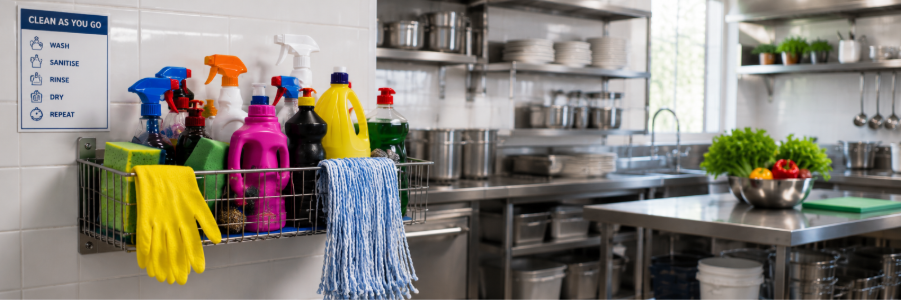
Rather than treating cleaning as an end-of-shift task, many kitchens benefit from building short cleaning intervals into the middle of service. Stationing cleaning equipment near high-traffic zones encourages staff to address spills as they happen rather than postponing cleanup, which helps minimise slip hazards and bacterial spread. Positioning equipment where it’s genuinely needed, rather than tucked away in a storeroom, removes one of the biggest barriers to consistent cleaning behaviour.
Streamlining Waste and Spill Management
Placing waste bins and spill stations closer to prep areas reduces the temptation to deal with mess later rather than immediately. Keeping cleaning products correctly labelled and stored ensures staff reach for the right product for the right surface, rather than improvising with whatever is closest. Clear labelling also supports faster, safer decision-making during busy periods, when there’s little time to stop and check.
Rethinking Bench and Zone Allocation
Assigning specific benches or sections to raw versus ready-to-eat food, even in smaller kitchens, reduces accidental crossover. Where physical separation isn’t possible, colour-coded boards, cloths and utensils can achieve much the same result without requiring a redesign of the space itself. Small visual cues, such as coloured tape marking zones on a bench, also help new or casual staff orient quickly without needing constant supervision.
How Can Staff Training Improve Kitchen Safety Habits?
Workflow changes only stick when staff understand the reasoning behind them. Short, regular refreshers on colour-coded equipment, correct handwashing steps and safe food storage temperatures help embed good habits rather than relying on memory alone. Involving staff in identifying workflow bottlenecks also increases buy-in, since they’re usually best placed to notice where a process breaks down in practice.
Training works best when paired with visible, easy-to-follow systems. A colour-coded chart near the cleaning station or a simple checklist at handover can reinforce verbal training long after the session itself has ended. Revisiting training periodically, rather than treating it as a one-off induction task, helps standards hold steady as teams change over time.
What Equipment Supports Safer Kitchen Workflows?
Well-organised kitchens rely on equipment that matches the task at hand. This includes colour-coded cleaning tools to prevent cross-contamination between zones, accessible sanitising stations, and clearly labelled storage for chemicals. Equipment that’s easy to reach and simple to use is far more likely to be used correctly and consistently, especially during busy service periods when shortcuts are most tempting.
Reviewing equipment placement periodically, rather than assuming the original layout still works, is a simple habit that pays off as menus, staff and service styles evolve. What suited a kitchen’s workflow a year ago may no longer reflect how the space is actually being used today, so a brief walkthrough every few months is worth the time it takes.
Improving food safety doesn’t always call for major renovations or new systems. Often, it’s the smaller, considered changes, adjusting when cleaning happens, where supplies are kept, and how staff move through the space, that make the most lasting difference. For businesses in healthcare, aged care and hospitality, these small workflow improvements support both compliance and genuine peace of mind for the people relying on safe, well-prepared food every day.
References:
- Food Standards Australia New Zealand (2023) Food safety standards for food service and retail. Accessed: 10 July 2026.
- NSW Food Authority (2024) Food safety guidelines for businesses.
- Safe Work Australia (2024) Managing health and safety risks in commercial kitchens. (Accessed: 10 July 2026).