A flawless hair colour result is never just about the formula in the bowl. The tools used to apply, section and process the colour are what determine whether the result is clean and precise or uneven and in need of correction. For colourists working across highlights, root touch-ups, balayage, full head colour and toning services, the right tools at the station are as important as the right product on the shelf.
Whether you are setting up a new colour station, refreshing your kit or sourcing tools for a salon team, three items form the core of a professional colour toolkit: a reliable Universal Aluminium Foil for section isolation, a Sofeel Carbon Fibre Fine Tooth Comb for precise parting and weaving, and a quality tinting brush for controlled product application.
Why Do Professional Hair Colour Tools Matter for Salon Success?
Professional hair colour tools help salons deliver more consistent results, improve workflow efficiency and create a better client experience. The right brushes, combs, foils and accessories allow stylists to work with greater control, reduce product waste and achieve the precision clients expect from professional colour services.
For salon owners, investing in reliable colour tools is not just about having the right equipment, it is about maintaining service standards, supporting stylist performance and building client trust. Quality tools help minimise application issues, improve efficiency during appointments and ensure every colour service reflects the professionalism of the salon.
The Three Essential Tools for Professional Hair Colouring
Isolate and Process Colour Sections with Professional Aluminium Foil
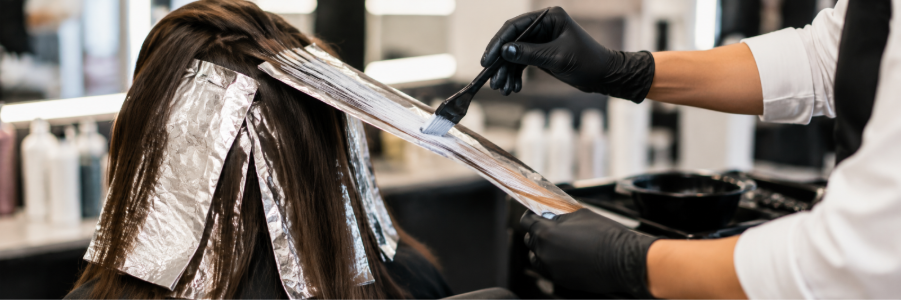
Aluminium foil is one of the most essential consumables in professional colour and lightening services. It wraps around each hair section to isolate colour or lightener from the surrounding hair, helps retain heat during processing to support even development, and must perform reliably from the first section to the last without tearing, cracking, or compromising the final result.
The Universal Aluminium Foil is designed for professional salon use, providing a reliable surface for a wide range of colouring and lightening techniques. Suitable for everything from fine highlight weaves to wider balayage panels, it helps maintain clean sectioning and precise product placement throughout the service. The roll format allows colourists to cut each sheet to the required length, providing greater flexibility across different techniques, hair lengths, and client hair volumes while supporting consistent, efficient application throughout the working day.
Part and Weave with a Comb Built for the Chemical Environment
The comb is one of the most important precision tools in professional colour services. It creates the partings that define exactly where colour begins and ends, weaves the fine strands that determine the depth and density of highlights, and distributes product evenly during toning, glossing, and other colour applications. The accuracy of every parting and weave directly influences the finished result, making comb quality an essential part of a professional colour workflow.
Carbon fibre is the preferred material for professional colour combs because it is lightweight, chemically resistant, heat resistant, and anti-static. Its anti-static properties are particularly valuable during colour services, where static can cause fine or lightened hair to lift away from the section, making clean partings and precise weaves more difficult to achieve.
Apply Colour With Precision Using a Professional Tinting Brush
The tinting brush is the primary delivery tool for colour product, and its performance has a direct bearing on how evenly and consistently the formula reaches the hair. A brush that holds too little product requires constant reloading, which slows the service and creates uneven saturation across sections. One with too much flexibility in the bristle provides insufficient control for root application and detail work. A brush with the right bristle density and firmness allows the colourist to saturate each section fully in a single pass, work precisely at the root line without bleeding onto the scalp, and paint through sections with even coverage from mid-length to ends.
Tinting brushes are also used across multiple colour techniques beyond straightforward root application. In balayage, the brush is used to paint freehand colour through sections with a sweeping motion. In root smudging and colour melting, it blends two shades at the transition zone. For full head colour, it distributes product systematically from root to tip. Each technique benefits from a brush that is purpose-built for colour application rather than repurposed from another tool type.
How to Use These Tools Together in a Professional Colour Service
What Is the Correct Sequence for a Foil Colour or Highlight Service?
Each of the three tools plays a role at a specific stage of the colour service, and using them in the right sequence produces the cleanest, most controlled result:
- Consult and prepare – Assess the client’s hair condition, current colour and the desired result before beginning. Confirm any contraindications including scalp sensitivity, known allergies or recent chemical treatments.
- Shampoo and section – Cleanse the hair to the appropriate level for the technique. Use the fine tooth comb and metal tail pin to divide the hair into clean working sections, securing each with a clip to maintain order throughout the service.
- Mix the colour formula – Prepare the formula in a colour bowl at the correct ratio according to the manufacturer’s directions.
- Load the tinting brush and apply – Using the tinting brush, apply the colour formula to each section with consistent pressure and coverage. For root application, work precisely at the parting line; for balayage, use a sweeping freehand motion; for full lengths, work from root to tip in a single pass.
- Weave and foil highlight sections – Where highlights are being applied, use the fine tooth comb to weave sections of the desired thickness, fold each section into a pre-cut foil and crimp the base firmly to prevent product seeping between sections.
- Monitor and remove – Process according to the formulation and the client’s hair history. Remove foils carefully, rinse thoroughly and apply any toner or finishing treatment.
- Advise on aftercare – Provide clear guidance on colour-safe product use, heat protection and the recommended timeframe for the next appointment.
Frequently Asked Questions About Hair Colour Application Tools
What foil gauge is best for professional salon use?
18 micron is the most widely used gauge in professional colour environments. It provides the strength to hold a fully loaded colour or lightener section through processing without tearing, and the pliability to fold and crimp cleanly at speed. Thicker foils resist neat folding; thinner foils tear too readily under product weight.
Why is a fine tooth comb better than a wide tooth comb for colour services?
Fine tooth combs create sharper, more defined partings and allow for more precise weaving of highlight sections. Wide tooth combs are better suited to detangling and distributing conditioner through wet hair. For colour work where the parting line determines exactly where colour is placed, a fine tooth comb with a metal tail pin gives the colourist the level of precision the technique requires.
Can a carbon fibre comb be used with bleach and lightener products?
Yes. Carbon fibre combs are specifically suited to chemical environments including bleach and developer exposure. Unlike standard plastic combs, they do not warp, soften or develop surface roughness with repeated exposure to peroxide or lightener product, maintaining clean tooth spacing and smooth edges through extended professional use.
The difference between a colour result that clients rave about and one that requires an immediate fix almost always comes down to precision: how cleanly the sections were parted, how consistently the product was applied and how reliably the foil held the section through processing. Each of the three tools covered in this guide addresses one part of that equation directly.
A professional-grade foil that performs under salon conditions, a carbon fibre comb that holds up to chemical exposure and delivers accurate partings and weaves, and a quality tinting brush that gives the colourist full control over product placement together form the toolkit that consistent, high-quality colour work is built on. Livingstone’s professional colour tool range provides these essentials in formats suited to individual colourists, busy salon teams and hair education environments.
References
- Australian Government. (n.d.). SIHHCLS303A – Design and perform full and partial highlighting techniques. Training gov.au.
- Hair Colour for Hairstylists. (n.d.). Foiling placement and technique. BCcampus Open Education.
- ICM Education. (n.d.). The art of colouring and lightening hair.
- Modern Salon. (2017). Five great reasons to foil highlight.