Frequent cleansing is important in healthcare, aged care and workplace first aid, but repeated contact with harsh products can contribute to dryness and discomfort. Choosing a wipe suited to the intended task can support both hygiene practice and skin comfort.
Why Is Skin-Friendly Hygiene Important in Care Settings?
Skin-friendly hygiene helps workers, carers and patients cleanse appropriately while limiting unnecessary dryness, stinging and irritation. Repeated washing, glove use and exposure to cleansing agents can affect the skin barrier. Selecting fit-for-purpose products and supporting good hand-care practices can improve comfort without replacing required infection-control procedures.
The correct product depends on the task. A wipe intended for hand cleansing may not be suitable for wound cleansing, environmental disinfection or clinical hand hygiene moments that require an approved alcohol-based hand rub.
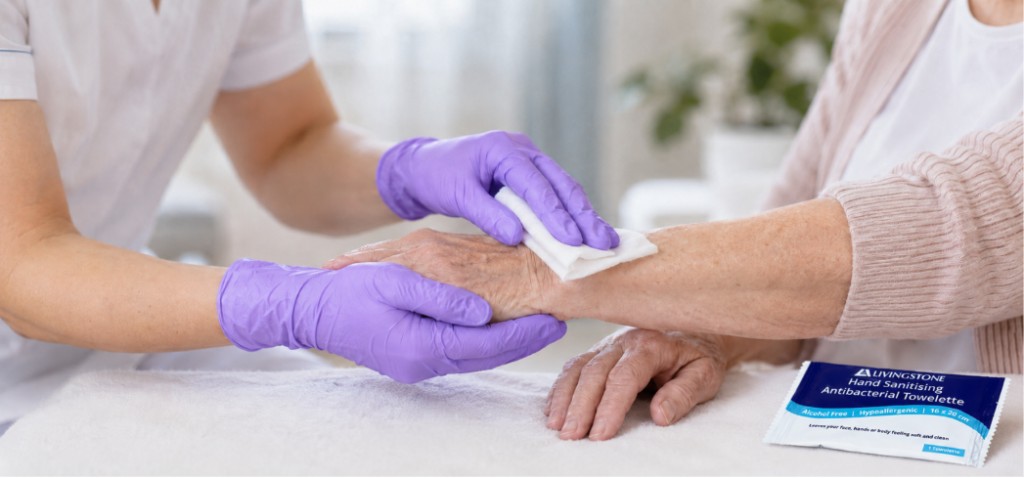
The individually wrapped Livingstone Hand Sanitising Antibacterial Towelette Wipe provides a compact option for appropriate hand-cleansing use in first aid kits, vehicles and mobile care supplies.
What Is the Livingstone Hand Sanitising Wipe?
The Livingstone hand sanitising wipe is a non-alcoholic antibacterial towelette supplied in an individual 16 x 20 cm pack. The single sachet format is portable and supports controlled dispensing for appropriate hand-cleansing situations. Users should check the label and directions before applying it for any other purpose.
Individually wrapped wipes are convenient for first aid kits, mobile staff, vehicles and hygiene stations. The sealed sachet helps keep the wipe ready until required.
The product should be stored as directed and discarded if the sachet is damaged, leaking or beyond its stated shelf life.
Organisations planning stock across several locations can explore Livingstone’s workplace hygiene collection after assessing the needs of each kit, site and work area.
When Is an Antibacterial Towelette Single Pack Useful?
An antibacterial towelette single pack is useful when portability, controlled dispensing and convenient storage matter. It can be placed in workplace first aid kits, travel kits, vehicles or care supplies for appropriate hand cleansing. Individual packaging also reduces the need to open a shared tub for one application.
- Workplace and vehicle first aid kits
- Mobile care and community support bags
- Reception or shared amenity areas
- Travel and event supplies
- Personal emergency kits
- Locations where compact storage is important
How Can Hand Sanitising Wipes Support Workplace First Aid?
Hand sanitising wipes can support workplace first aid by providing a compact cleansing option where access to handwashing facilities is limited or additional portable supplies are useful. They should be selected for the intended task, stored correctly and used alongside the workplace’s broader first aid and hygiene arrangements.
Safe Work Australia advises workplaces to provide appropriate first aid equipment and access to facilities based on workplace needs. Stock selection should reflect hazards, workforce size, location and response arrangements
A wipe does not replace soap and water when hands are visibly dirty, nor does it automatically meet clinical hand hygiene requirements.
What Should Organisations Consider When They Bulk Buy First Aid Supplies?
Organisations that bulk buy first aid supplies should review expected usage, individual packaging, storage conditions, shelf life and distribution across sites. For hand wipes, buyers should confirm formulation, intended use and compatibility with workplace procedures. Stock rotation and routine kit inspections help keep supplies accessible and serviceable.
Order quantities should reflect consumption rather than simply the lowest unit price. Excess stock can expire or deteriorate in unsuitable storage, while insufficient stock can leave kits incomplete.
Assign responsibility for checking sachets and replenishing kits after use.
Are Non-Alcoholic Wipes Equivalent to Alcohol-Based Hand Rub?
Non-alcoholic wipes are not automatically equivalent to alcohol-based hand rub. They may suit labelled hand-cleansing applications, but approved alcohol-based hand rub remains recommended for many clinical hand hygiene moments. Healthcare workers should follow infection-prevention procedures and use the product specified for the particular task and setting.
The Australian Commission on Safety and Quality in Health Care identifies hand hygiene as a core infection-prevention measure. Product choice, technique and timing all matter.
Do not use a hand-sanitising wipe on open wounds unless its directions specifically permit that application.
How Should Individually Wrapped Wipes Be Stored and Checked?
Store individually wrapped wipes in a clean, dry place within the temperature range stated by the manufacturer. Inspect sachets during routine first aid checks and replace any that are torn, leaking, dried out or expired. Keep stock organised so older supplies are used first where appropriate.
- Keep sachets away from excessive heat and moisture
- Check packaging integrity and expiry information
- Rotate stock during scheduled first aid inspections
- Replenish supplies promptly after use
- Follow disposal instructions and workplace waste procedures
Balancing Hygiene, Comfort and Practical Supply
The livingstone hand sanitising wipe provides a portable, non-alcoholic option for appropriate hand cleansing. Its antibacterial towelette single-pack format suits compact first aid and workplace storage.
When organisations bulk buy first aid supplies, product selection should remain tied to intended use, infection-control requirements, storage and regular stock checks.
References
- Australian Commission on Safety and Quality in Health Care (n.d.) Infection prevention and control.
- Safe Work Australia (n.d.) First aid.