When seconds count in an emergency, the equipment your team relies on can determine patient outcomes. The Livingstone Rapid Rescue Automatic Loading Ambulance Stretcher is an advanced patient transport solution engineered specifically for high-pressure emergency response environments. With a 60-degree back angle, low position design, and compact 190 x 60 x 24 cm profile, this stretcher delivers the speed, safety, and clinical precision that modern paramedics, first responders, and healthcare facilities demand.
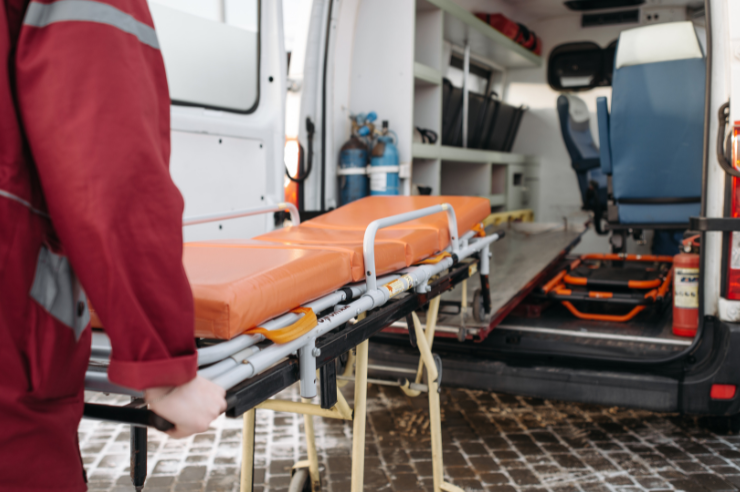
What Is the Livingstone Rapid Rescue Automatic Loading Ambulance Stretcher?
The Livingstone Rapid Rescue Automatic Loading Ambulance Stretcher is a professional-grade emergency stretcher designed for rapid patient extraction and transport. It features an automatic loading mechanism that significantly reduces the manual effort required during patient transfer, minimising the risk of occupational injury for ambulance officers and first responders.
Key technical specifications include:
- Back angle: 60 degrees, supporting patient positioning for respiratory comfort and clinical assessment
- Dimensions: 190 x 60 x 24 cm in low position
- Design: Low-profile entry position for ground-level or low-access patient retrieval
- Mechanism: Automatic loading system for streamlined ambulance integration
This stretcher is not simply a mobility aid. It is a frontline rescue tool purpose-built for Australian emergency services, hospital environments, and workplace first aid teams.
Why Does Stretcher Design Matter in Emergency Response?
The Role of Patient Positioning in Pre-Hospital Care
Incorrect patient positioning during transport can worsen existing injuries, compromise airways, and elevate the risk of secondary trauma. The 60-degree back angle on this stretcher supports semi-recumbent positioning, which is clinically beneficial for patients experiencing:
- Respiratory distress or breathing difficulties
- Chest trauma or rib fractures
- Haemodynamic instability requiring monitored positioning
- Reduced consciousness or post-resuscitation recovery
Appropriate back elevation can reduce the work of breathing and support venous return, making this feature critical in pre-hospital and inter-facility transport scenarios.
How Does Automatic Loading Reduce Injury Risk for First Responders?
Manual handling of patients is one of the leading causes of musculoskeletal injury among ambulance officers in Australia. According to Safe Work Australia, body stressing injuries account for the highest proportion of serious workers’ compensation claims in the health care sector (Safe Work Australia, 2023).
The automatic loading mechanism on this stretcher reduces the physical demand placed on responders during vehicle loading. Rather than manually lifting a fully-loaded stretcher into an ambulance, the self-loading function allows for a controlled, mechanical transition that protects both the patient and the operator.
What Are the Core Features of This Ambulance Stretcher?
Low Position Design for Ground-Level Access
The low-profile 24 cm height in the down position allows responders to position the stretcher directly beside a patient on the ground, enabling safer and more efficient transfer from scene to stretcher. This is particularly important in:
- Road traffic accident responses
- Industrial workplace emergencies
- Rural and remote retrieval scenarios
- Confined space rescues
Compact and Clinically Relevant Dimensions
At 190 x 60 x 24 cm, the stretcher accommodates adult patients while maintaining manoeuvrability in tight hospital corridors, narrow doorways, and small emergency vehicle bays. The 60 cm width provides adequate patient support without impeding responder access during treatment in transit.
Built for Australian Emergency Standards
Australian emergency services operate under rigorous clinical and occupational health standards. This stretcher aligns with the functional requirements of first responder teams across metropolitan, regional, and remote settings, making it a practical investment for healthcare procurement teams and ambulance service coordinators.
Who Should Use the Livingstone Rapid Rescue Ambulance Stretcher?
This stretcher is suited to a wide range of professional users and healthcare contexts, including:
- Ambulance services and paramedic teams requiring reliable, repeatable loading performance
- Hospital emergency departments managing inter-ward or inter-facility patient transfers
- Industrial and mining sites where workplace first aid and emergency evacuation protocols are mandatory
- Event medical teams operating across large-scale public events
- Defence and tactical medical units requiring compact, rapid-deployment patient transport
For organisations building or upgrading emergency response kits, the stretcher pairs effectively with broader first aid and rescue equipment available through Livingstone’s emergency and rescue range.
How Does This Stretcher Compare to Manual Alternatives?
Traditional manual stretchers require significant physical exertion during vehicle loading, particularly when navigating uneven terrain or working with bariatric patients. The automatic loading mechanism on this Livingstone model reduces loading time, decreases the number of personnel required for safe transfer, and supports compliance with occupational health and safety obligations.
For emergency medical services and workplace health and safety managers, investing in automatic-loading equipment is both a clinical and legal consideration. The Occupational Health and Safety Act and associated codes of practice across Australian jurisdictions require employers to eliminate or minimise manual handling risks wherever reasonably practicable (Safe Work Australia, 2023).
Frequently Asked Questions
What does the 60-degree back angle mean for patient care?
A 60-degree back angle means the upper section of the stretcher can be elevated to support semi-upright patient positioning. This is clinically recommended for patients with breathing difficulties, suspected spinal injuries requiring monitored positioning, or those recovering from cardiac events during transport.
Is this stretcher suitable for all emergency environments?
Yes. The combination of a low-profile base, adjustable back angle, and automatic loading makes this stretcher adaptable across pre-hospital emergency scenes, hospital wards, and workplace first aid situations.
Can one person operate this stretcher?
The automatic loading mechanism is designed to support reduced-crew operations, though best practice in emergency transport typically involves a minimum of two trained operators to ensure patient safety.
Conclusion: Equipping Your Team for Faster, Safer Emergency Response
The Livingstone Rapid Rescue Automatic Loading Ambulance Stretcher represents a meaningful advancement in patient transport equipment. Its combination of automatic loading, a 60-degree adjustable back angle, and a low-profile 190 x 60 x 24 cm design addresses the real demands faced by Australian emergency responders and healthcare facilities daily.
Choosing the right emergency equipment is not a procurement afterthought. It is a clinical decision with direct implications for patient outcomes and responder safety. Explore the full range of professional emergency and rescue solutions to build a response capability that meets Australian standards and saves lives when it matters most.
References
Safe Work Australia 2023, Key work health and safety statistics Australia 2023, Safe Work Australia, Canberra, viewed 15 June 2026, https://www.safeworkaustralia.gov.au/safety-topic/managing-health-and-safety/identify-assess-and-control-hazards
Hospital + Healthcare 2021, Powered stretchers reduce injuries for paramedics, Hospital + Healthcare, viewed 15 June 2026, https://www.hospitalhealth.com.au/content/design-in-health/article/powered-stretchers-reduce-injuries-for-paramedics-1003135949
Ambulance Victoria 2025, Health, Safety and Wellbeing, Ambulance Victoria Annual Report 2024–25, viewed 15 June 2026, https://www.ambulance.vic.gov.au/annual-report-2024-25/health-safety-and-wellbeing