A food thermometer is the only reliable way to confirm that meat, poultry and reheated meals have reached a safe internal temperature, since colour and juices cannot be trusted on their own. Getting an accurate reading depends on using the right tool, a probe thermometer for spot checks across a wide temperature range, or a fold-out digital food thermometer for quick, everyday kitchen use. This guide covers the safe temperatures to aim for, how to use a thermometer correctly, and the mistakes that most often lead to an inaccurate reading.
Why Does Food Temperature Matter for Food Safety?
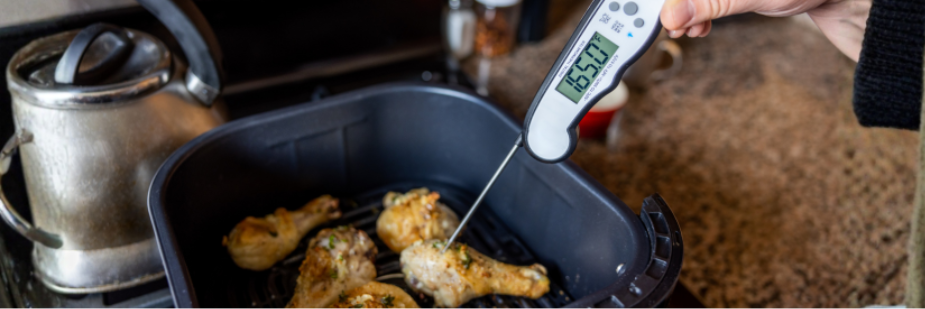
Cooking food to the correct internal temperature destroys harmful bacteria such as Salmonella, Listeria and E. coli. Keeping food out of the temperature danger zone, between 5 degrees Celsius and 60 degrees Celsius, stops that bacteria multiplying. A food thermometer is the only reliable way to confirm both.
Bacteria grow fastest between 5 degrees Celsius and 60 degrees Celsius, which is why this range is known as the temperature danger zone. Hot food needs to stay at or above 60 degrees Celsius and refrigerated food at or below 5 degrees Celsius. Relying on appearance to judge whether food sits inside or outside this range is unreliable, particularly with dense cuts of meat, casseroles or reheated leftovers, where the surface temperature can differ significantly from the centre.
What Are the Safe Internal Temperatures for Different Foods?
Safe internal cooking temperatures vary by food type. Whole chicken and poultry pieces need to reach 74 degrees Celsius, minced meat and sausages need 71 degrees Celsius, and reheated leftovers need to reach 60 degrees Celsius throughout. A thermometer removes the guesswork that colour and juices cannot reliably resolve.
What Temperature Should Chicken, Mince and Reheated Food Reach?
Different foods carry different levels of bacterial risk, so the safe temperature varies accordingly. Whole chicken, turkey, thighs, wings and breasts should reach 74 degrees Celsius. Minced meat and sausages, which have greater surface area exposed to bacteria, should reach 71 degrees Celsius. Beef, veal, lamb and pork can be cooked to 63 degrees Celsius for medium rare with a rest period, 71 degrees Celsius for medium, or 77 degrees Celsius for well done. Fish should reach 63 degrees Celsius, and reheated leftovers should be heated through to at least 60 degrees Celsius. These figures reflect current NSW Food Authority cooking temperature guidance and checking them with a probe removes any doubt that pink meat or clear juices alone cannot settle.
How Do You Use a Food Thermometer Correctly?
Insert the probe into the thickest part of the food, avoiding bone, fat and the cooking container, then wait for the reading to stabilise before recording it. Testing more than one spot helps confirm even cooking, particularly in larger cuts or whole poultry.
Where Should You Insert the Probe?
For roasts and whole poultry, insert the probe into the thickest part of the meat, typically the innermost part of the thigh for chicken, without touching bone. For thinner cuts, mince dishes or casseroles, insert the probe centrally and check more than one location if the dish is large or unevenly shaped. Wait until the reading holds steady rather than taking the first number that appears, since digital probes can take several seconds to settle.
How Do You Clean and Store a Food Thermometer?
A probe that has touched raw meat can spread bacteria to the next food it contacts, so the stem should be washed with warm water and detergent, then sanitised, between each use. Allow it to air dry or wipe it with a clean paper towel rather than a cloth that may already carry contamination. Store the thermometer in its case or a clean, dry spot away from raw food preparation areas.
What Are the Most Common Food Thermometer Mistakes?
Common mistakes include judging doneness by colour instead of temperature, testing too close to bone or the pan, skipping the probe clean between different foods, and never checking calibration. Any one of these can produce a reading that looks safe when the food is not.
Why Colour and Juices Aren’t Reliable Indicators
Pink meat is not always undercooked, and clear juices do not always mean food is safe. Colour can be affected by the cut, the cooking method and even the age of the meat, while juices run clear well before the centre of a dense cut reaches a safe temperature. A thermometer reading is the only measure that removes this guesswork.
How Often Should You Calibrate a Food Thermometer?
Food thermometers should be checked periodically using the ice water method, where a probe placed in a slurry of ice and water should read close to 0 degrees Celsius. If the reading drifts, the thermometer needs recalibrating or replacing before its next use.
To check calibration, fill a container with crushed ice and a small amount of water, stir well, and insert the probe without letting it touch the sides or base. Wait for the reading to stabilise; it should sit close to 0 degrees Celsius. Recalibrate after the thermometer has been dropped, after a sudden temperature change, or on a regular schedule if it is used daily in a commercial kitchen or clinical setting.
Does a Food Thermometer Need Calibration Before First Use?
Yes. New thermometers should be checked against the ice water method before their first use, even straight out of the packaging. This confirms the reading is accurate from the start rather than assuming factory calibration is correct for your specific unit.
Can You Use the Same Thermometer for Raw and Cooked Meat?
Only if the probe is cleaned and sanitised between uses. Using an unclean probe straight from raw meat on cooked or ready-to-eat food risks cross-contamination, which can undo the safety benefit of cooking the food correctly in the first place.
What Is the 2-Hour/4-Hour Rule for Food Safety?
The 2-hour/4-hour rule applies to food held within the temperature danger zone of 5 degrees Celsius to 60 degrees Celsius. If the cumulative time is under 2 hours, the food can still be used or refrigerated. Between 2 and 4 hours, it must be used immediately. Beyond 4 hours, it should be discarded.
References:
NSW Food Authority 2023, Temperature Danger Zone, NSW Department of Primary Industries, accessed 20 August 2026, <https://www.foodauthority.nsw.gov.au/media/1356>.
NSW Food Authority 2024, Cooking Temperatures, NSW Department of Primary Industries, accessed 20 August 2026, <https://www.foodauthority.nsw.gov.au/consumer/food-at-home/cooking-temperatures>.