A resident who usually walks confidently to breakfast may become unsteady after a sleepless night or a change in medication. The corridor looks the same, yet the risk has changed. That is why falls prevention in aged care cannot rely on warning signs and tidy floors alone.
WA Health’s No Falls November encourages conversations about fall risks in hospitals and residential aged care homes. For care teams, it is an opportunity to examine how personal health, surroundings and daily routines influence safe movement.
Suitable equipment also plays a role in falls prevention. Livingstone offers a range of mobility aids and patient care essentials that aged care facilities can consider based on residents’ individual needs and clinical assessments. Facilities can explore Livingstone’s Resident Care Supplies Range and broader Healthcare Collection when reviewing products for assisted mobility and everyday resident care. Selecting appropriate equipment as part of a broader falls prevention plan can help residents move more safely while maintaining their independence.
Why Are Falls a Particular Concern in Residential Aged Care?
Falls in residential aged care can arise from combinations of poor balance, muscle weakness, dizziness, medicines, vision changes and environmental hazards. Risks differ between residents and may change suddenly. Prevention involves recognising individual contributing factors and acting on those that can be managed, while preserving appropriate opportunities for movement.
A resident may feel dizzy when standing, struggle to reach the bathroom in time or become less steady following an infection. The circumstances surrounding an incident often reveal more than the location alone. Repeated near misses at the same point may signal an awkward transfer or a problem with timing.
Staff can look for patterns: Is the person unsteady during early morning transfers? Are they rushing because their call bell is out of reach? Has their footwear changed?
The 2025 Australian residential aged care falls guidelines emphasise tailored interventions for people living in care. Observations should therefore inform specific actions, not simply add another score to a form.
When Should Aged Care Teams Review a Resident’s Falls Risk?
Falls prevention plans should be reviewed when a resident enters care, experiences a fall or near miss, or shows changes in health, mobility, cognition or medication. Assessment should involve the resident and relevant clinicians. The resulting instructions need to be clear enough to guide assistance during ordinary shifts.
An admission assessment cannot account for every later change. A new prescription, fatigue after illness or increasing difficulty getting out of a chair may warrant further clinical review.
A GP can investigate possible medicine-related dizziness; a physiotherapist or occupational therapist may recommend transfer techniques or equipment.
Care staff also need ready access to suitable everyday items, such as call bells and prescribed personal care equipment. Positioning these within reach can help residents request assistance instead of making unsafe attempts to obtain them.
Changes should be recorded and shared at handover so the agreed approach is followed consistently. A scheduled follow-up helps confirm whether recommended adjustments have made a difference.
How Can Facilities Make Bedrooms and Walkways Safer?
Practical environmental checks can identify loose mats, poor lighting, spills, obstructed walkways and belongings placed beyond easy reach. Bedrooms, bathrooms and corridors should be assessed according to residents’ actual movement patterns. Equipment placement and cleaning arrangements should reduce hazards without making familiar spaces harder to navigate.
A useful inspection follows the resident’s route from bed to bathroom, including during the night.
Staff can check:
- Floor surfaces: Remove trip hazards and deal promptly with wet areas.
- Lighting: Keep key routes visible without uncomfortable glare.
- Personal items: Position glasses, call bells and commonly used belongings within reach.
- Bathroom access: Check suitable grab rails and space for any prescribed mobility aid.
Livingstone’s Resident Care Supplies campaign offers a starting point for reviewing day-to-day care needs. Cleaning consumables and appropriate protective wear are also relevant when staff respond to spills under workplace procedures. The important result is the removal of an identified hazard, not the purchase itself.
A resident may also need their walking aid parked on a particular side of the bed. The decisive step is identifying a real hazard and correcting it.
Which Walking Aids Should Aged Care Residents Use?
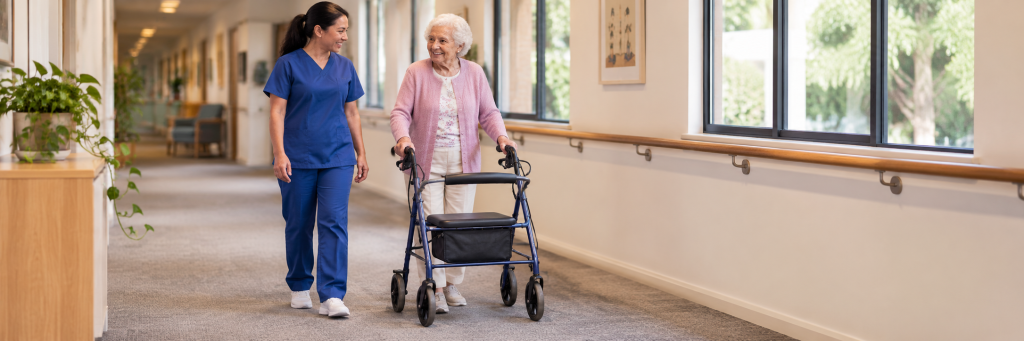
Walking frames and rollators can assist residents who need additional stability, but selection depends on strength, balance, cognition and the setting. A clinician should assess the appropriate device, fit and technique. Incorrectly sized or poorly maintained equipment can create hazards, even when it appears suitable for everyday use.
A fixed walking frame and a wheeled rollator are not interchangeable. Some residents need greater stability, while others can safely manage wheels and brakes after assessment.
Staff should check the frame’s condition, confirm the required settings and ensure it is available at the point where the resident normally stands.
Trialling the aid along bedroom and bathroom routes can reveal practical difficulties before it becomes part of the care plan. Before ordering multiple frames, compare individual assessments with product dimensions and available adjustment settings.
Can Strength and Balance Activities Reduce Falls Risk?
Appropriately designed strength and balance exercise can reduce falls risk among older people, including residents of aged care homes. Activity should reflect personal ability, goals and clinical advice. Restricting movement unnecessarily may contribute to weakness, so prevention plans should consider safe ways to maintain physical function.
Fear of falling can lead residents to avoid walking, particularly after an injury. Prolonged inactivity may then make routine movements more difficult.
The national falls guidelines recommend ongoing, tailored exercise programs for residents who wish to participate. Supervised standing practice, balance activities or short walks may be suitable, depending on assessment.
A walking aid might be used during an approved activity, but it does not replace exercise planning or supervision.
Progress can be measured by practical achievements, such as transferring more confidently from a chair. Staff should work with physiotherapists and other qualified practitioners to adapt activities as circumstances change. Residents who dislike one activity may prefer another, so discuss options with them.
What Should Staff Do After a Fall or Near Miss?
Following a fall, staff should follow local post-fall procedures, assess the resident for injury and seek appropriate clinical assistance. They should document the circumstances and review possible contributors. Near misses also offer valuable information, allowing changes before a similar event causes injury.
Immediate actions depend on the situation. Suspected head injury, severe pain or other concerning symptoms require prompt escalation according to facility protocols. Moving a resident before possible injuries are assessed can cause harm.
Documentation should cover the activity, location, symptoms, equipment and relevant observations, including what the resident recalls.
Facilities also need their patient care and first aid supplies accessible for authorised staff responding under established procedures. Having supplies nearby does not replace clinical assessment.
Afterwards, the team should decide whether the care plan, medication review, environment or mobility arrangements need to change, and communicate those decisions at handover. Report near misses even without injury, as they may reveal hazards before someone is hurt.
How Can No Falls November Shape Everyday Aged Care Practice?
No Falls November can prompt practical changes through resident conversations, staff education, hazard checks and reviews of mobility arrangements. Its value comes from turning awareness into specific actions, recording what changes and continuing successful measures after the campaign rather than treating falls prevention as a once-a-year activity.
WA Health provides resources designed to help staff discuss risks with older people and encourage participation in fall prevention.
A facility could use the month to check whether mobility aids are correctly fitted, identify overnight walking hazards and review arrangements for responding to spills. Residents can help prioritise the routes and activities they find most difficult.
Procurement teams can review Livingstone mobility aids and patient care supplies, as well as protective wear for tasks such as spill clean-up. Clinical staff still determine which equipment is suitable for individual residents.
Choose one issue identified during a resident conversation, assign responsibility for addressing it and review whether the change has worked. That turns a general awareness message into a useful local improvement.
References
Australian Commission on Safety and Quality in Health Care 2025, Falls Guidelines for Australian Residential Aged Care Services, Australian Government, viewed 3 November 2026.
https://www.safetyandquality.gov.au/resources/falls-guidelines-australian-residential-aged-care-services
Australian Commission on Safety and Quality in Health Care 2025, Preventing falls in residential aged care services, fact sheet, Australian Government, viewed 3 November 2026.
https://www.safetyandquality.gov.au/sites/default/files/resources/attachments/fact-sheet-preventing-falls-in-residential-aged-care-services.pdf
WA Health 2026, No Falls November, 12 October, Government of Western Australia, viewed 3 November 2026.
https://rph.health.wa.gov.au/sitecore/content/Corporate/News/2026/No-Falls-November
WA Health 2026, No Falls November campaign, Government of Western Australia, viewed 3 November 2026.
https://rph.health.wa.gov.au/sitecore/content/Corporate/Articles/A_E/Campaign-No-Falls-November