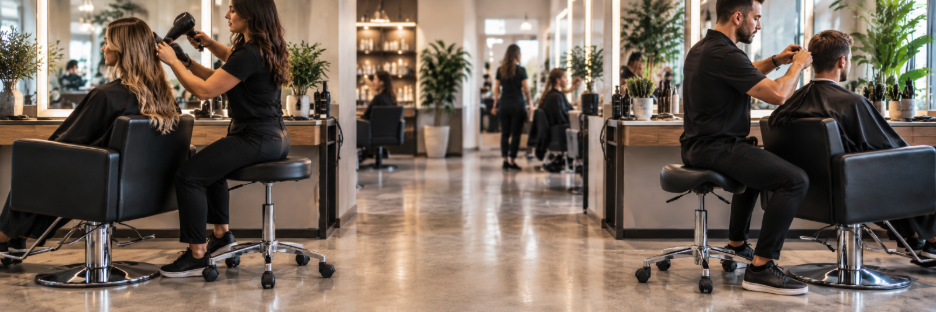
Disposable neck strips help hair salons create a fresh, single-use barrier between the client’s neck and the salon cape while reducing the amount of loose hair that can travel down the neck and clothing. They can support client comfort, cleaner service preparation and a more consistent professional hairdressing routine.
Neck strips are particularly useful during haircutting and barbering services where small hair clippings can collect around the collar. They do not replace appropriate cleaning or laundering of reusable salon linen, but they provide an additional disposable contact layer that is removed after each client.
The Sofeel Elastic Neck Strip is a self-adhesive, elastic and water-resistant strip designed to help stop stray hair from travelling down a client’s neck and clothing. The matching Sofeel Neck Strip Dispenser keeps the roll contained and readily accessible for convenient use at a professional workstation.
What Are Disposable Neck Strips and Why Do Hair Salons Use Them?
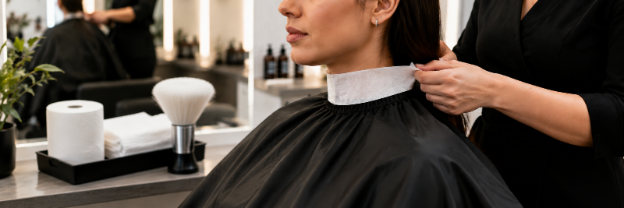
Disposable neck strips are single-use strips positioned around the client’s neck beneath a salon cape or gown. They provide a fresh contact layer for each service, help keep loose hair away from the neck and clothing, and can improve comfort around the collar during haircuts, barbering and other professional hair services.
Professional salons can incorporate neck strips into their normal gowning procedure before placing the salon cape around the client. After the service, the used strip should be removed and discarded rather than reused. A neck strip should be considered one part of good salon hygiene rather than a replacement for appropriate cleaning, linen handling, hand hygiene and other infection-prevention procedures.
What Infection Control Practices Do Neck Strips Support in Hair Salons?
Neck strips can support salon hygiene by creating a fresh, single use contact layer beneath the cape for each client. However, Australian infection-control guidance does not identify neck strips as a substitute for clean linen. Hair salons must still follow applicable requirements for clean equipment, linen, work areas and hygienic service practices.
Neck strips can complement these procedures by creating an additional disposable layer where the cape meets the neck, but salons should not rely on a neck strip as a reason to use visibly soiled or inadequately managed reusable linen.
How Do Neck Strips Help Reduce Cross-Contact Between Clients?
Neck strips help reduce direct contact between a client’s skin and a reusable salon cape by creating a fresh disposable layer around the collar area. Because each strip is discarded after use, the same neck strip is not shared between clients, supporting a more controlled and consistent approach to salon hygiene.
Victorian health guidance describes the risk of infection transmission in hairdressing as low but confirms that infection can still occur during some hairdressing and barbering procedures. Businesses should therefore continue following recognised infection prevention practices.
A neck strip should be viewed as a useful barrier rather than something that completely eliminates cross-contamination. Cape hygiene, hand hygiene, clean tools and appropriate environmental cleaning remain important parts of the broader salon process.
How Should Disposable Neck Strips Be Used in a Hair Salon?
Disposable neck strips should be applied as a fresh barrier for each client before the salon cape is secured. The strip should sit comfortably around the neck without excessive tightness, provide coverage between the skin and cape collar, and be removed and discarded after the service rather than reused on another client.
A practical process includes:
- Prepare the client. Seat the client and ensure the neck area is ready before applying the cape.
- Dispense a fresh strip. Remove one pre-cut neck strip from the roll.
- Position the strip. Wrap the strip comfortably around the neck according to its self-adhesive design, ensuring it sits flat without unnecessary tightness.
- Apply the salon cape. Position the cape over the neck strip so the strip forms a barrier between the client’s skin and the collar area.
- Complete the service. During cutting, the strip helps reduce stray hair travelling inside the collar and onto the client’s clothing.
- Discard after use. Remove the strip after the service and dispose of it. Do not reuse a single-use strip on another client.
Why Is a Self-Adhesive Neck Strip Useful in a Salon?
A self-adhesive neck strip simplifies client preparation because it can be secured without requiring a separate clip, pin or fastening accessory. This reduces the number of items required during gowning and provides staff with a straightforward, repeatable way to position a fresh disposable barrier around the client’s neck before applying the cape.
For busy salons and barbershops, these features can make client preparation easier to organise across repeated appointments while maintaining the core principle that a fresh neck strip is used for each applicable service.
Why Are Disposable Neck Strips Useful for Hair Salon Hygiene and Comfort?
Disposable neck strips support hair salon hygiene and client comfort by creating a fresh, single-use barrier between the client’s neck and the salon cape. They also help prevent loose hair clippings from reaching the skin and clothing, contributing to a cleaner, more comfortable and professionally managed service experience.
When used correctly, disposable neck strips can make client preparation more consistent across salons and barbershops while supporting an organised gowning process. Combined with clean linen, hygienic equipment and appropriate infection-prevention practices, they provide a practical addition to everyday salon hygiene and help maintain a polished standard of client care.
References
Queensland Health (2025) Personal appearance services: legislation. Queensland Government. Available at:
https://www.health.qld.gov.au/public-health/industry-environment/personal-appearance/services/legislation
Victorian Department of Health (2019) Hairdressing and make-up application: infection prevention and control. Victorian Government. Available at: