
Surgical instrument trays, such as the Livingstone’s stainless steel instrument tray with cover, come in a range of standard sizes designed to suit different instrument sets, procedure types and sterilisation equipment. A wider selection of trays, holloware and plasticware is also available for facilities needing options beyond a single standard size.
Choosing the correct tray size affects far more than storage convenience. It influences how efficiently instruments are cleaned and sterilised, and how well they fit into washer disinfectors and autoclaves.
What Sizes Do Surgical Instrument Trays Typically Come In?
Surgical instrument trays are typically available in small, medium and large formats, ranging from around 170mm by 110mm up to 480mm by 250mm or larger, with depths generally between 20mm and 60mm depending on the instruments they are designed to hold.
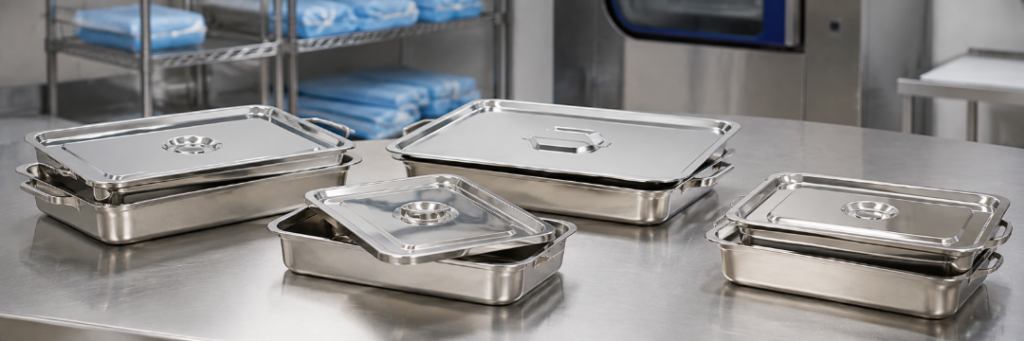
Smaller trays, often used for minor procedure sets or individual instrument cassettes, suit compact groups such as suture removal kits or dressing packs. Mid-range trays, commonly around 300mm by 200mm, are widely used for general surgical instrument sets. Larger trays, sometimes exceeding 480mm in length, hold extensive instrument sets for major procedures or nest multiple smaller trays together during sterilisation.
Why Are There Different Depths for Surgical Instrument Trays?
Different tray depths accommodate different instrument types, with shallow trays suited to flat items like scalpels and scissors, and deeper trays designed to hold bulkier items such as retractors, forceps sets or stacked instrument layers.
A tray that is too shallow may not fully contain taller instruments, increasing the risk of damage or contamination during handling. A tray that is unnecessarily deep can reduce steam or chemical penetration during sterilisation if instruments are packed too densely. Matching tray depth to instrument type supports both protection and effective reprocessing.
How Does Tray Size Affect Sterilisation Compatibility?
Tray size affects sterilisation compatibility because autoclaves and washer disinfectors have fixed chamber dimensions, meaning trays must be sized to fit standard racking systems while still allowing adequate steam or chemical circulation around each instrument.
Under AS 5369:2023, the current Australian standard for reprocessing reusable medical devices, health service organisations must ensure that reprocessing equipment and instrument packaging support effective cleaning, disinfection and sterilisation outcomes (Standards Australia, 2023). Trays that are too large for a chamber, or packed beyond capacity, can compromise sterilisation efficacy. Facilities typically standardise on a small number of tray sizes to simplify compatibility across autoclaves and washer disinfectors.
Do Surgical Instrument Trays Follow an International Sizing Standard?
Many surgical instrument trays follow DIN sizing conventions, a European standard widely adopted internationally, which defines base tray dimensions and allows trays and baskets from different manufacturers to be nested or stacked consistently within sterilisation containers.
DIN sizing typically starts from a base unit of around 480mm by 250mm, with smaller trays sized as fractions of this base unit. While not all Australian facilities strictly follow DIN measurements, many tray ranges are designed with similar proportions to support compatibility with common sterilisation containers already in use across hospitals and day surgeries.
How Do You Choose the Right Tray Size for a Procedure?
The right tray size for a procedure depends on the number and type of instruments required, the sterilisation equipment available, and whether the tray needs to nest with other trays or fit within an existing storage or transport system.
Selecting an appropriately sized tray reduces the risk of overcrowding instruments, which can affect both sterilisation quality and ease of use during a procedure. Facilities preparing instrument sets should consider:
- The total number of instruments in the set
- The size and shape of the largest instruments included
- Compatibility with existing autoclave and washer disinfector racking
- Whether the tray needs a lid for storage or transport
- Consistency with other trays used across the facility
Should Trays Have Lids for Storage and Transport?
Yes, trays used for storage or transport should generally have lids, as a cover helps protect sterilised instruments from contamination and physical damage between the point of sterilisation and use.
Lidded trays are particularly useful for instruments sterilised and stored ahead of a scheduled procedure or transported between a central sterile supply department and a procedure room. Trays used solely within a sterilisation cycle may not require a lid, provided the facility’s workflow maintains appropriate handling standards throughout.
What Should Facilities Consider When Standardising Instrument Tray Sizes?
Facilities should consider instrument set requirements, sterilisation equipment dimensions, storage space and staff familiarity when standardising instrument tray sizes, aiming to reduce the number of different sizes in circulation without compromising instrument protection.
Reducing variation across tray sizes simplifies staff training, procurement and stock management, while still allowing enough flexibility to accommodate different instrument sets. Many facilities settle on two or three core tray sizes, supplemented with a small number of specialty sizes for procedures with unique instrument requirements.
What Is the Most Common Surgical Instrument Tray Size Used in Australia?
A mid-range tray around 300mm to 360mm in length and 200mm to 260mm in width is among the most used sizes in Australian hospitals and day surgeries, offering enough capacity for general surgical instrument sets while remaining compatible with standard sterilisation equipment.
This size range strikes a practical balance between capacity and manoeuvrability, suiting a wide range of general surgical, dental and procedural instrument sets. Facilities with more specialised needs, such as orthopaedic or ophthalmic procedures, often supplement this standard size with purpose-built trays.
References
- Standards Australia 2023, AS 5369:2023 Reprocessing of reusable medical devices and other devices in health and non-health related facilities, viewed 11 August 2026, https://www.standards.org.au/blog/spotlight-on-as-5369-2023
- Australian Commission on Safety and Quality in Health Care 2023, Transitioning from AS/NZS 4187:2014 to AS 5369:2023, viewed 11 August 2026, https://www.safetyandquality.gov.au