
University microbiology practicals use different culture media because each supports different observations. Nutrient Broth is supplied as a fine, buff-coloured dehydrated powder. When prepared with water according to instructions, it becomes a liquid culture medium. Tryptone Soya Agar (TSA) is also supplied dehydrated and forms a solid agar medium after preparation.
Understanding the distinction between the product as supplied and the medium after preparation is important. Both products begin as dehydrated powders, but their prepared forms support different microbiological observations. Their prepared pH, typical use and handling requirements also help determine which medium is appropriate for a practical.
What is the difference between Nutrient Broth and Tryptone Soya Agar?
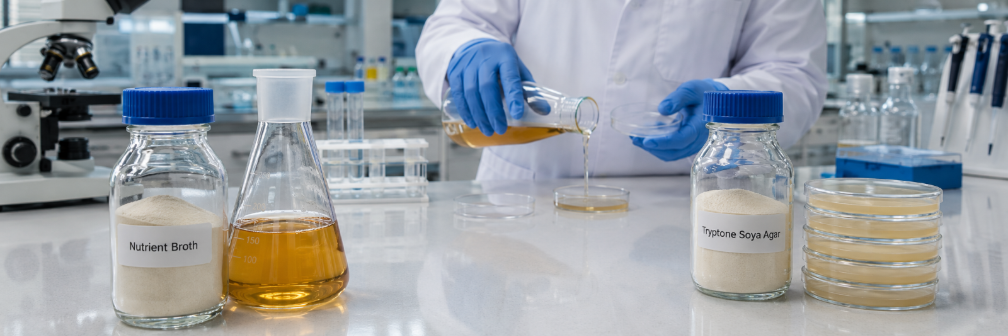
Both Nutrient Broth and Tryptone Soya Agar are supplied as fine, buff-coloured dehydrated powders. The key difference appears after preparation: Nutrient Broth produces a liquid culture medium for growth in suspension, while TSA forms a solid agar surface that supports colony development, isolation, and observation.
Both dehydrated media are prepared with water, with TSA requiring heating to dissolve completely before sterilisation. When prepared according to instructions, Nutrient Broth has a pH of 7.4 ± 0.2 and is used as a liquid culture medium, whereas TSA has a pH of 7.3 ± 0.2 and is prepared as a solid agar medium. These prepared formats determine their different laboratory applications.
What is Nutrient Broth used in the laboratory?
Prepared Nutrient Broth is used when microorganisms need to grow throughout a liquid culture rather than on a solid surface. Typical applications include routine cultivation, inoculum preparation, and observing growth through turbidity, provided by the organism; incubation conditions and laboratory methods are suitable.
In university practicals, the dehydrated Nutrient Broth powder is first prepared as directed to produce the liquid medium. After inoculation and incubation, increased turbidity can provide a visible indication of microbial growth when interpreted against an appropriate uninoculated control. The resulting broth culture may also be used in a subsequent microbiological procedure.
What is Tryptone Soya Agar used for microbiology?
Tryptone Soya Agar is supplied as a dehydrated powder and is prepared to form a solid culture surface. The prepared medium is used for colony isolation, subculturing, streaking exercises, and observation of colony characteristics, provided the microorganism and incubation conditions are suitable for the selected method.
After the dehydrated TSA powder is prepared, the agar provides a firm surface on which microorganisms can develop as separate colonies. This makes the medium useful when students need to examine visible colony characteristics or select isolated colonies for further work. Organisms with specialised nutritional or environmental requirements may require another culture medium.
When should you use Nutrient Broth instead of Tryptone Soya Agar?
Use Nutrient Broth when the dehydrated powder needs to be prepared as a liquid culture medium for growth in suspension, turbidity observation, or inoculum preparation. Use TSA when the dehydrated powder needs to be prepared as a solid agar surface for colony isolation, examination, or transfer.
The most useful decision is based on the prepared medium required by the practical. Nutrient Broth starts as a dehydrated powder but is prepared for liquid culture, while TSA also starts as a dehydrated powder but is prepared to provide a solid agar surface. The organism, method, and required observation should guide selection.
Can Nutrient Broth and Tryptone Soya Agar be used together in microbiology workflows?
Yes. Once the dehydrated media have been prepared, Nutrient Broth and Tryptone Soya Agar can be used within the same microbiology workflow when both liquid cultivation and solid-surface growth are required. A broth culture may be transferred onto prepared TSA for colony development, isolation, or further observation.
This sequence can demonstrate the difference between microorganisms growing throughout a prepared liquid broth and developing separate colonies on a prepared agar surface. It can also support practical teaching of inoculation, transfer, streaking, and subculturing. Not every experiment requires both media, so the workflow should follow the relevant teaching protocol and microbiological safety requirements (Adelaide University, 2025; Curtin University, n.d.).
How should dehydrated Nutrient Broth and Tryptone Soya Agar be handled and stored?
Neither dehydrated medium is classified as hazardous under GHS, but the fine powders should still be handled carefully to minimise dust, ingestion and contact with the eyes or skin. Keep containers tightly closed in a cool, dry, well-ventilated area below 25°C and away from strong light.
Large amounts of dust may cause respiratory tract discomfort, transient eye discomfort or mild gastric disturbance if ingested, while prolonged or repeated skin exposure may cause mild blemishing in some individuals. Use suitable eye protection, gloves and protective clothing, maintain adequate ventilation and wash hands after handling. They are not regarded as fire hazards, although large quantities may present a dust explosion hazard. Disposal should follow the workplace and applicable waste procedures. The products are stable under the storage and handling conditions specified in their respective SDS
Nutrient Broth vs Tryptone Soya Agar: Which one should you choose?
Choose Nutrient Broth when a practical requires a dehydrated culture medium that will be prepared for microbial growth in liquid suspension. Choose Tryptone Soya Agar when the prepared medium must provide a solid surface for visible colony development. Selection should reflect the organism, experimental objective, laboratory method, and safety controls.
For university students, the key distinction is not the form of the products in their containers, because both are supplied as fine dehydrated powders. The difference is their prepared use: Nutrient Broth provides a liquid growth environment, while TSA provides a solid agar surface for colony development and observation. Correct preparation, storage, handling, and microbiological safety practices remain important for both media.
References
Adelaide University (2025) Biosafety and Compliance Procedure. Available at: https://adelaide.edu.au/about/policies/research-integrity-policy/biosafety-and-compliance-procedure/ (Accessed: 20 August 2026).
Curtin University (n.d.) Training and Guidelines: Microbiological Safety and Containment Standard. Available at: https://www.curtin.edu.au/healthandsafety/hazardous-materials/biological/training/ (Accessed: 20 August 2026).