
An overbed table gives patients and carers a stable surface for meals, reading, devices and everyday care tasks. The Livingstone overbed table is designed for use beside a bed or chair, where its height can be adjusted to suit the user and the activity. For more equipment options, explore Livingstone’s First Aid and Workplace Safety Equipment collection.
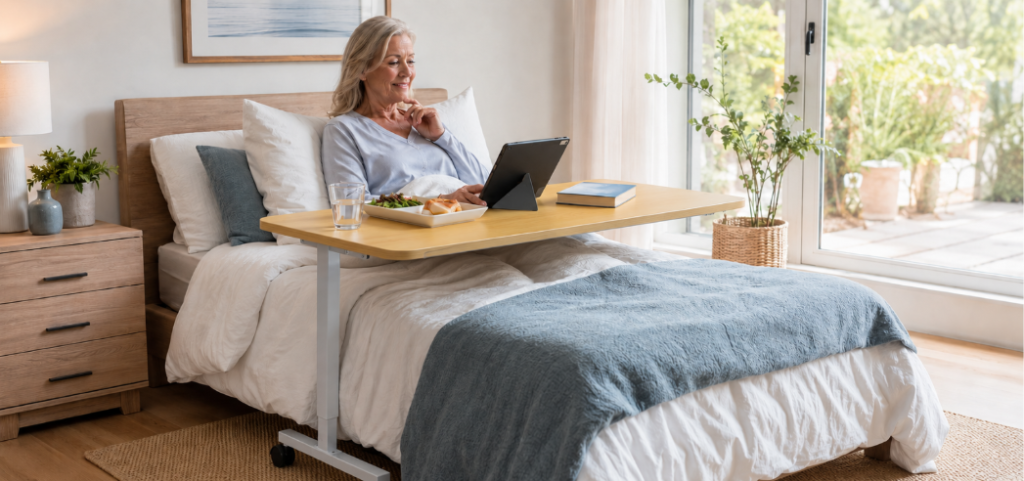
Why Is an Adjustable Bedside Table Useful in Home Care?
An adjustable bedside table keeps meals, drinks, medication, books and devices within comfortable reach. It can reduce unnecessary bending or stretching, support independent routines and give carers a practical work surface. Height adjustment also helps the table suit different beds, chairs and everyday activities.
For people recovering from illness, living with limited mobility or receiving long-term support, reaching a standard bedside cabinet may be difficult. A mobile table can be positioned where it is needed and moved away when the area must be cleared.
The table should be set to a comfortable height before use. Carers should also check that the base is stable and the tabletop is not overloaded.
What Are the Main Benefits of a Overbed Table?
An overbed table supports eating, reading, personal care and device use from a bed or chair. Its adjustable height and practical tabletop improve access for patients and carers. The mobile design can also help staff reposition the surface as care needs change throughout the day.
For facilities considering this type of equipment, the Livingstone Overbed Table has an 80 x 40 cm top and adjusts from 77 to 124 cm, making it suitable for a range of bedside activities.
- Keeps frequently used items within reach
- Provides a stable surface for meals and drinks
- Supports reading, writing and tablet use
- Assists with selected personal-care tasks
- Adjusts for different beds, chairs and users
- Can be moved aside to support transfers and cleaning
How Can an Overbed Table Support Independence and Comfort?
An overbed table supports independence by allowing a person to complete suitable daily activities without repeatedly asking for assistance. A correctly positioned surface can make eating, reading and communication easier, while reducing awkward reaching. This may improve comfort, confidence and participation in everyday routines.
Independence does not mean removing support. Users with reduced strength, cognition or balance may still need help positioning the table or managing hot food and drinks.
Personal items should remain organised so that the user can reach them safely without leaning beyond the bed or chair.
What Should Buyers Check When Sourcing Wholesale Hospital Furniture?
When sourcing wholesale hospital furniture, buyers should assess dimensions, adjustment range, stability, mobility, surface durability and cleaning requirements. Equipment must suit the intended users, bed types and care environment. Procurement teams should also consider replacement parts, storage, staff training and routine inspection procedures.
Buyers can also compare related options in Livingstone’s First Aid and Workplace Safety Equipment collection when planning equipment for different rooms and care needs.
For an adjustable bedside table, confirm that the base will fit around the intended bed or chair and that the full height range is appropriate. Check the manufacturer’s instructions before using cleaning agents on the tabletop, frame or moving components.
The Livingstone model has an 80 x 40 cm wooden top and adjusts from 77 to 124 cm, providing a practical working range for many care situations.
How Should an Adjustable Bedside Table Be Used Safely?
Use an adjustable bedside table on a level surface, set it to the required height and confirm it is stable before placing items on top. Keep pathways clear, avoid overloading the table and move it away during transfers when necessary. Follow the product instructions for adjustment, cleaning and maintenance.
- Check the frame and moving parts before use
- Place heavier items near the centre of the tabletop
- Keep hot drinks away from edges
- Do not use the table to support body weight unless expressly permitted
- Clean spills promptly and dry the surface
- Remove damaged or unstable equipment from service
Where Are Overbed Tables Commonly Used?
Overbed tables are commonly used in hospitals, aged care facilities, rehabilitation centres, disability support settings and private homes. They provide a flexible surface beside beds, recliners and chairs, supporting meals, recreation, communication and selected care tasks without requiring major changes to the room layout.
The most suitable configuration depends on the room, flooring, bed design and user. Facilities should include the table in routine cleaning and equipment checks, particularly where it is shared between users.
Supporting Practical Care at the Bedside
A well-positioned Livingstone overbed table can make daily care more comfortable and organised. As an adjustable bedside table, it gives users a convenient surface while helping carers manage common tasks efficiently.
For organisations purchasing wholesale hospital furniture, suitability should be assessed against the people, spaces and procedures in each facility rather than price alone.